
Introduction – E-commerce Boom in India
India’s e-commerce industry continues to experience remarkable growth in 2026. Rising smartphone penetration, expanding digital payment adoption, improved logistics networks, and increasing consumer confidence in online shopping have transformed the way businesses sell products and services. From startups and D2C brands to large enterprises, organizations across industries are investing heavily in ecommerce website development 2026 strategies to capitalize on growing digital demand.
Today’s consumers expect lightning-fast websites, seamless mobile experiences, secure payment processing, AI-powered personalization, flexible delivery options, and frictionless checkout journeys. Businesses that fail to deliver optimized shopping experiences risk losing customers to competitors offering more convenient and engaging digital platforms.
The Indian e-commerce ecosystem has also become significantly more competitive. Building a successful online store now requires more than attractive design. Businesses must combine performance optimization, scalability, SEO, conversion-focused UI/UX, advanced analytics, automation, and AI-driven customer experiences to achieve sustainable growth.
Whether launching a Shopify store, WooCommerce website, Adobe Commerce platform, or custom ecommerce solution, selecting the right technology stack and development strategy remains critical to long-term success.
This guide explores the latest ecommerce best practices, platform comparisons, conversion optimization techniques, development costs, SEO strategies, and security standards businesses need to build high-performing e-commerce websites in 2026.
E-commerce Platform Comparison 2026
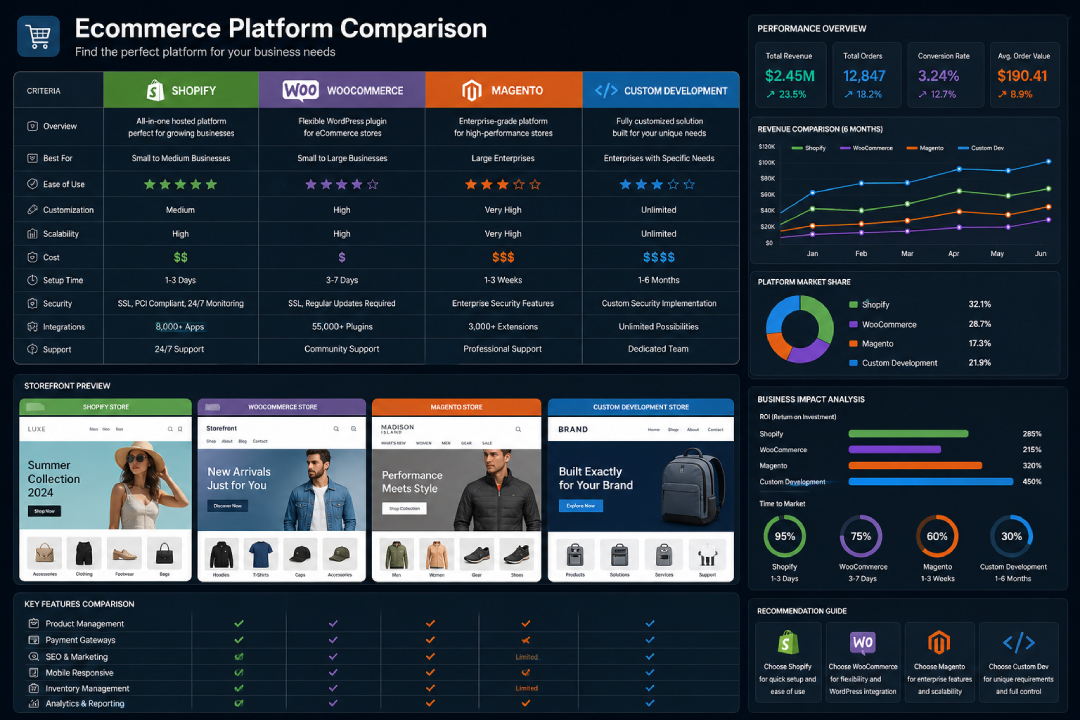
Choosing the right platform remains one of the most important decisions in ecommerce website development 2026. Every platform offers different strengths in scalability, customization, performance, integrations, and operational flexibility. Businesses should evaluate their budget, technical requirements, growth plans, and long-term maintenance needs before making a decision.
― Shopify
Shopify remains one of the world’s most popular ecommerce platforms due to its simplicity, scalability, and rapid deployment capabilities. It is particularly well-suited for startups, small businesses, and fast-growing D2C brands.
Shopify provides:
- Hosted cloud infrastructure
- Easy product management
- Secure payment integrations
- Mobile-first design capabilities
- Extensive app ecosystem
- Built-in hosting and security
One of Shopify’s biggest advantages is speed to market. Businesses can launch fully functional online stores quickly without worrying about server management or infrastructure maintenance.
Shopify also supports:
- Multi-channel commerce
- Inventory management
- AI-powered automation tools
- Advanced customer analytics
- Subscription-based commerce
- Social commerce integrations
However, Shopify can have limitations in highly customized ecommerce environments and may involve additional recurring costs through premium apps and transaction fees.
It remains an excellent option for businesses focused on:
- Rapid store deployment
- Simplified management
- Scalable growth
- Mobile commerce optimization
- Operational efficiency
Shopify Development continues to be a preferred choice among India’s expanding D2C and retail ecommerce sectors.
― WooCommerce
WooCommerce remains one of the most flexible ecommerce solutions available, offering businesses full control over their online stores through the WordPress ecosystem.
Its popularity continues to grow because of its customization capabilities, extensive plugin marketplace, and strong SEO potential.
Key advantages include:
- Open-source flexibility
- Large plugin ecosystem
- Excellent SEO capabilities
- Cost-effective implementation
- Seamless WordPress integration
- Complete content management control
WooCommerce is particularly suitable for:
- Content-driven ecommerce businesses
- SEO-focused online stores
- Medium-sized ecommerce operations
- Businesses requiring custom workflows
Because it is built on WordPress, WooCommerce enables businesses to combine ecommerce functionality with blogs, landing pages, educational content, and content marketing strategies.
However, WooCommerce requires:
- Hosting management
- Regular security updates
- Plugin maintenance
- Performance optimization
Without proper development and optimization practices, WooCommerce stores may encounter performance challenges as traffic and product catalogs grow.
In the ongoing shopify vs woocommerce vs adobe commerce discussion, WooCommerce continues to stand out for flexibility and content-focused ecommerce strategies.
― Magento / Adobe Commerce
Adobe Commerce, formerly Magento, remains one of the most powerful ecommerce platforms available for enterprise organizations and large-scale online businesses.
It offers advanced capabilities including:
- Multi-store management
- Enterprise-grade scalability
- Advanced catalog management
- Complex inventory systems
- B2B ecommerce functionality
- Personalized commerce experiences
Large organizations choose Adobe Commerce because of its ability to support highly customized ecommerce ecosystems and massive product inventories.
Adobe Commerce is particularly suitable for:
- Enterprise ecommerce businesses
- Large online marketplaces
- Global ecommerce operations
- Complex inventory environments
- High-volume sales platforms
However, Adobe Commerce requires experienced development teams, robust hosting infrastructure, and higher ongoing maintenance investments.
Despite its higher cost, it remains one of the most scalable and feature-rich ecommerce solutions available in 2026.
― Custom Development
Custom ecommerce development provides maximum flexibility for businesses requiring unique functionality, advanced integrations, specialized workflows, or fully customized customer experiences.
Unlike platform-based solutions, custom development enables businesses to create ecommerce ecosystems tailored entirely to their operational requirements.
Modern custom ecommerce platforms commonly utilize technologies such as:
- Laravel
- React.js
- Next.js
- Node.js
- Headless commerce architectures
- AI-powered integrations
Custom development is often preferred for:
- Enterprise marketplaces
- AI-driven ecommerce platforms
- Subscription commerce businesses
- Large D2C ecosystems
- Multi-vendor marketplaces
Major advantages include:
- Unlimited scalability
- Complete UI/UX flexibility
- Advanced system integrations
- Optimized performance
- Future-ready architecture
However, custom development typically involves:
- Higher development investment
- Longer implementation timelines
- Dedicated maintenance requirements
- Greater technical expertise
For businesses seeking complete ownership, advanced functionality, and long-term scalability, custom ecommerce development remains one of the most powerful options available.
Must-Have Features for 2026
Modern ecommerce websites must go beyond basic online shopping functionality to remain competitive in 2026. Consumer expectations continue to evolve, requiring businesses to deliver intelligent, personalized, and highly optimized digital experiences.
― Mobile-First Design
Mobile commerce continues to dominate online shopping behavior across India and global markets. Businesses must prioritize responsive design, fast mobile performance, and frictionless user experiences.
Mobile-first ecommerce websites should include:
- Responsive layouts
- Touch-friendly navigation
- Fast-loading product pages
- Mobile-optimized checkout
- Integrated mobile payment options
Poor mobile experiences can significantly increase bounce rates and reduce conversion opportunities.
― Fast Checkout
Checkout optimization remains one of the most important ecommerce best practices for increasing conversions and reducing cart abandonment.
Modern shoppers expect:
- One-page checkout experiences
- Guest checkout functionality
- Autofill support
- Multiple payment options
- Fast transaction processing
Reducing friction during checkout directly improves customer satisfaction and sales performance.
― AI Recommendations
AI-powered personalization has become a core component of ecommerce website development 2026 strategies.
Advanced recommendation engines analyze:
- Browsing behavior
- Purchase history
- Customer preferences
- Product interactions
This allows businesses to deliver:
- Personalized product suggestions
- Dynamic upselling opportunities
- Cross-selling recommendations
- Smarter search experiences
AI-driven personalization helps improve engagement, conversions, and average order value.
― Multiple Payment Gateways
Consumers increasingly expect flexibility when making online purchases. Modern ecommerce websites should support:
- UPI payments
- Credit and debit cards
- Net banking
- Digital wallets
- Buy Now Pay Later (BNPL) services
- International payment methods
A flexible payment ecosystem improves trust and reduces transaction abandonment.
― Advanced Analytics
Data-driven decision-making remains essential for ecommerce success.
Advanced analytics platforms help businesses monitor:
- User behavior
- Sales trends
- Traffic sources
- Conversion funnels
- Cart abandonment rates
- Customer lifetime value
Modern ecommerce stores also benefit from:
- AI-powered reporting
- Heatmap tracking
- Predictive customer insights
- Automated inventory forecasting
Businesses investing in intelligent ecommerce features gain stronger competitive advantages in customer acquisition, retention, and long-term revenue growth.
Conversion Optimization Strategies
Building an ecommerce website is only the first step. Sustainable success depends on continuously optimizing the store for higher conversions, stronger customer retention, and improved user experiences.
One of the most effective optimization strategies is improving website speed. Slow-loading websites increase bounce rates, reduce customer trust, and negatively impact search rankings. Businesses should focus on:
- Image optimization and compression
- Content Delivery Network (CDN) implementation
- Efficient caching mechanisms
- Code minification and optimization
- High-performance hosting infrastructure
Navigation also plays a critical role in conversion optimization. Customers should be able to find products quickly through:
- Intelligent search functionality
- Advanced product filtering
- Predictive search suggestions
- AI-powered recommendations
Product pages should be designed to maximize purchasing confidence and conversion rates. High-converting product pages typically include:
- High-quality product images
- Product demonstration videos
- Verified customer reviews
- Transparent pricing information
- Trust signals and guarantees
- Prominent call-to-action buttons
Trust-building elements remain essential for ecommerce success. Businesses should clearly display:
- SSL security certifications
- Secure payment badges
- Return and refund policies
- Shipping and delivery information
- Customer testimonials
Personalization has become one of the most powerful ecommerce best practices in 2026. AI-driven systems help businesses deliver highly relevant shopping experiences based on customer behavior, interests, and purchase history.
Cart abandonment recovery remains another critical revenue optimization strategy. Businesses can recover lost sales through:
- Automated email sequences
- Exit-intent offers
- Retargeting advertisements
- Personalized discount campaigns
UI/UX design also significantly influences conversion performance. Clean interfaces, intuitive navigation, and frictionless user journeys contribute to higher engagement and customer satisfaction.
Successful ecommerce brands continuously test and optimize:
- CTA button placements
- Checkout workflows
- Homepage messaging
- Product page layouts
- Promotional campaigns
Ongoing optimization helps businesses improve customer experiences and maximize revenue growth over time.
Development Cost Breakdown
Understanding ecommerce development cost india is essential for businesses planning digital commerce investments in 2026.
Development costs vary based on several factors, including:
- Platform selection
- Design complexity
- Custom feature requirements
- Third-party integrations
- Scalability requirements
- Security and compliance needs
― Shopify Development Costs
Basic Shopify stores typically range between ₹60,000 and ₹3,00,000 depending on design customization and feature requirements.
Advanced Shopify implementations featuring:
- Custom UI/UX design
- Subscription commerce functionality
- ERP integrations
- AI-powered personalization
- Advanced automation systems
can require significantly higher investments.
Recurring costs may include:
- Shopify subscription plans
- Third-party app licenses
- Payment processing fees
- Maintenance and support services
― WooCommerce Development Costs
WooCommerce remains one of the most cost-effective ecommerce solutions for businesses seeking flexibility and ownership.
Common expenses include:
- Web hosting
- Theme customization
- Plugin licensing
- Security implementation
- SEO optimization
Medium-sized WooCommerce projects generally range from ₹80,000 to ₹6,00,000 depending on complexity and customization requirements.
― Magento Development Costs
Adobe Commerce remains one of the most expensive ecommerce platforms due to its enterprise-grade capabilities.
Development expenses often include:
- Enterprise hosting infrastructure
- Adobe Commerce licensing
- Custom module development
- Security hardening
- Performance optimization
Large enterprise Adobe Commerce projects frequently exceed ₹10,00,000 and can scale significantly higher based on requirements.
― Custom Ecommerce Development Costs
Custom ecommerce development offers maximum flexibility but typically involves larger investments.
Custom projects often include:
- UI/UX design
- Frontend development
- Backend development
- API integrations
- AI and automation features
- Mobile application integration
- Cloud infrastructure setup
Development costs commonly range from ₹3,00,000 to ₹30,00,000+ depending on complexity, scalability requirements, and business objectives.
Businesses should also account for long-term expenses such as maintenance, hosting, SEO, performance optimization, and security monitoring.
SEO for E-commerce
SEO continues to be one of the most valuable growth channels for ecommerce businesses in 2026. Organic traffic provides sustainable visibility, lower acquisition costs, and long-term customer acquisition opportunities.
Successful ecommerce SEO begins with a strong website architecture. Product categories, navigation structures, URLs, and internal linking should be designed to support both users and search engines.
Modern ecommerce SEO focuses heavily on:
- Search intent optimization
- User experience improvements
- Page speed performance
- Mobile usability
- High-quality content
Product pages should include:
- Keyword-optimized titles
- Unique product descriptions
- Structured data markup
- High-resolution optimized images
- Customer reviews
- FAQ sections
Technical SEO remains equally important. Businesses should optimize:
- Core Web Vitals
- Mobile responsiveness
- XML sitemaps
- Site crawlability
- Canonical tags
- Indexation management
Content marketing continues to drive ecommerce growth through:
- Buying guides
- Educational blog content
- Product comparisons
- Industry insights
- Video-based content
AI-powered search experiences are increasingly influencing rankings, making it important for businesses to prioritize:
- Helpful content
- User engagement signals
- Fast-loading experiences
- Trustworthiness and authority
- Personalized user journeys
Local SEO also remains important for Indian ecommerce brands targeting specific regions, languages, and local audiences.
Effective SEO implementation helps improve:
- Organic traffic growth
- Brand visibility
- Customer trust
- Conversion rates
- Long-term return on investment
Businesses that prioritize SEO-focused ecommerce development gain a significant competitive advantage in crowded online markets.
Security Considerations
Security remains one of the most important aspects of ecommerce website development 2026. Customers expect their personal information, payment details, and transactions to remain protected at all times.
Modern ecommerce websites must implement strong security measures to defend against:
- Data breaches
- Payment fraud
- Malware attacks
- Credential theft
- Unauthorized access attempts
SSL encryption remains essential for protecting customer data during transmission. Businesses should also implement:
- Secure payment gateways
- Multi-factor authentication
- Routine security audits
- Firewall protection
- Malware scanning and monitoring
PCI DSS compliance continues to be important for businesses processing payment information.
Additional security best practices include:
- Secure hosting environments
- Automated backup systems
- Role-based access controls
- API security management
- Continuous threat monitoring
AI-powered fraud detection solutions are becoming increasingly common across modern ecommerce ecosystems. These technologies help identify suspicious transactions and reduce financial losses.
Strong security practices enhance customer trust, protect sensitive information, maintain regulatory compliance, and safeguard business reputation.
As cyber threats continue to evolve in 2026, proactive security strategies remain essential for long-term ecommerce success.
Developer Infotech E-commerce Services
Developer Infotech provides scalable, secure, and conversion-focused ecommerce solutions tailored to modern business requirements in 2026. The company helps startups, D2C brands, SMEs, and enterprises build high-performing ecommerce platforms designed for long-term growth and customer engagement.
Services include:
- Shopify Development
- WooCommerce Development
- Adobe Commerce Development
- Custom Ecommerce Development
- UI/UX Design
- Mobile App Development
- Laravel Development
- AI Solutions
- Custom Software Development
Developer Infotech focuses on building ecommerce ecosystems that combine:
- High performance
- Conversion optimization
- Mobile-first experiences
- Advanced analytics
- AI-powered personalization
- Secure payment infrastructure
The development process includes strategic consultation, platform selection, UI/UX planning, SEO implementation, performance optimization, security enhancement, and scalability planning.
Whether businesses require a simple online store, subscription-based platform, B2B ecommerce solution, or enterprise marketplace, Developer Infotech delivers customized ecommerce systems aligned with business goals and customer expectations.
By combining modern technologies, ecommerce best practices, AI-driven innovation, and business-focused development strategies, Developer Infotech helps brands create powerful digital commerce experiences that drive measurable growth, customer loyalty, and long-term success.