Introduction to Backend Architecture
Backend architecture remains the foundation of every modern digital application, determining how data is processed, stored, secured, and delivered across systems. In 2026, businesses are prioritizing backend architecture patterns 2026 that support scalability, resilience, security, and performance as digital ecosystems continue to grow in complexity.
A well-designed backend enables seamless communication between servers, databases, APIs, cloud services, and third-party integrations. It directly impacts application responsiveness, reliability, maintainability, and overall user experience. With the continued expansion of cloud-native computing, AI-powered systems, edge infrastructure, and distributed architectures, backend development has evolved far beyond traditional server-side programming.
Today’s enterprises require scalable backend development strategies capable of handling millions of concurrent requests, real-time data processing, and global user bases without compromising availability or performance. This demand has accelerated the adoption of modern architectural approaches such as microservices, serverless computing, event-driven systems, and hybrid cloud architectures.
IT companies like Developer Infotech leverage these advanced architectures to build enterprise-grade solutions across web development, mobile applications, SaaS platforms, ecommerce ecosystems, AI-driven products, and custom software systems. Selecting the right backend architecture is no longer simply a technical decision—it is a strategic investment that directly influences long-term scalability, operational efficiency, cost optimization, and business growth.

Monolithic Architecture
Monolithic architecture remains one of the most widely recognized backend design patterns, where the entire application is developed and deployed as a single unified codebase. Components such as user management, business logic, APIs, and database operations are tightly integrated and managed together.
For startups, MVPs, and smaller applications, monolithic systems continue to offer significant advantages. Developers can build, test, and deploy applications quickly without the operational complexity associated with distributed systems.
The simplicity of a monolithic architecture often results in faster initial development, easier debugging, and more straightforward deployment processes. Development teams can manage the entire application within a single environment, reducing operational overhead during the early stages of a project.
However, as applications grow in size and complexity, monolithic systems can become increasingly difficult to scale and maintain. Even minor updates may require redeploying the entire application, increasing deployment risk and slowing development cycles.
From a microservices vs monolith perspective, monolithic architectures excel in simplicity but often struggle with long-term scalability, flexibility, and independent service management.
Despite the rise of cloud-native architectures, monoliths remain highly relevant for internal business systems, WordPress-based solutions, small ecommerce stores, and organizations that prioritize rapid development over complex scalability requirements.
Microservices Architecture
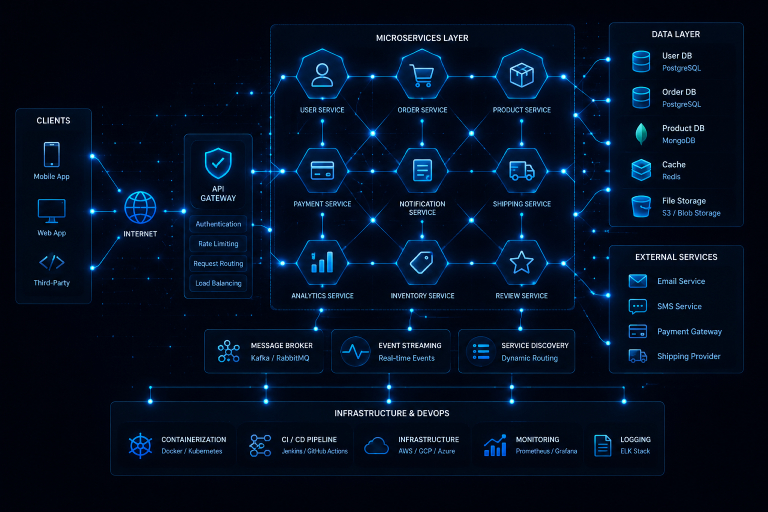
Microservices architecture continues to be one of the most influential approaches in modern backend architecture patterns 2026, particularly for enterprise-grade, cloud-native, and large-scale applications.
In a microservices architecture, an application is divided into multiple independent services, each responsible for a specific business capability. These services communicate through APIs, event streams, or messaging systems while remaining independently deployable and scalable.
This approach is widely adopted by organizations operating large ecommerce platforms, fintech applications, SaaS products, healthcare systems, logistics networks, and streaming services.
One of the primary advantages of microservices is scalability. Instead of scaling an entire application, businesses can allocate resources only to services experiencing increased demand. This significantly improves infrastructure efficiency and supports modern scalable backend development strategies.
Microservices also enable faster development cycles. Different teams can work independently on separate services using different technologies, frameworks, and deployment schedules. For example, one service may utilize Node.js while another leverages Laravel, Python, or Go.
This architectural flexibility supports innovation and allows organizations to adopt new technologies without impacting the entire application ecosystem.
However, microservices introduce additional complexity. Managing service discovery, API gateways, authentication, monitoring, observability, distributed tracing, and inter-service communication requires mature DevOps practices and robust infrastructure management.
Developer Infotech implements microservices using modern containerization technologies such as Docker, Kubernetes, service meshes, and cloud-native orchestration platforms to ensure high availability, resilience, and operational efficiency.
Serverless Architecture
Serverless architecture continues to gain momentum in 2026 as businesses seek greater agility, cost efficiency, and operational simplicity.
In a serverless model, developers focus exclusively on application logic while cloud providers automatically manage infrastructure provisioning, scaling, maintenance, and availability. Popular platforms such as AWS Lambda, Azure Functions, and Google Cloud Functions enable organizations to execute backend processes without maintaining dedicated servers.
Serverless architecture is particularly attractive for event-driven workloads, APIs, mobile backends, data processing pipelines, automation systems, and AI-powered applications.
One of its greatest advantages is cost optimization. Organizations only pay for actual resource consumption rather than maintaining idle infrastructure. This usage-based pricing model makes serverless solutions highly efficient for workloads with variable or unpredictable traffic patterns.
Automatic scalability is another significant benefit. As demand increases, cloud providers dynamically allocate resources without requiring manual intervention. When traffic decreases, resources scale down automatically, helping control costs.
Despite these benefits, serverless architecture still presents challenges. Cold-start latency, execution limits, vendor lock-in concerns, and debugging complexity can impact certain use cases, particularly those involving long-running processes or highly specialized infrastructure requirements.
Nevertheless, serverless continues to play a critical role in modern API architecture, automation workflows, event processing systems, and lightweight backend services.
Event-Driven Architecture
Event-driven architecture (EDA) has become increasingly important as organizations demand real-time responsiveness, scalability, and system flexibility.
In this architectural pattern, services communicate through events rather than direct synchronous requests. When an event occurs—such as a customer purchase, account update, payment confirmation, or sensor reading—it is published to an event broker. Other services subscribe to relevant events and react independently.
Popular technologies supporting event-driven systems include Apache Kafka, RabbitMQ, Amazon EventBridge, and cloud-native messaging platforms.
One of the biggest advantages of event-driven architecture is loose coupling. Services remain independent, allowing organizations to scale, modify, and deploy components without disrupting the broader system.
EDA also enables asynchronous processing, improving system responsiveness and supporting high-throughput environments where real-time processing is essential.
Industries such as fintech, ecommerce, logistics, telecommunications, healthcare, and IoT increasingly rely on event-driven architectures to support real-time analytics, transaction processing, notifications, and operational automation.
Additionally, event-driven systems improve resilience because failures within one service do not necessarily impact the entire application ecosystem.
However, organizations must address challenges related to monitoring, debugging, event ordering, data consistency, and distributed observability. Advanced monitoring and tracing tools are often required to maintain visibility across complex event flows.
As digital ecosystems continue to expand in 2026, event-driven architecture remains a key enabler of scalable, resilient, and highly responsive backend systems.
Layered/N-Tier Architecture
Layered or N-tier architecture remains one of the most widely adopted backend design approaches for business applications, enterprise systems, and structured software environments.
In this model, an application is divided into multiple logical layers, typically including presentation, business logic, data access, and database layers. Each layer has a clearly defined responsibility and communicates with adjacent layers through controlled interfaces.
This separation of concerns improves maintainability, code organization, testing efficiency, and long-term scalability. Development teams can modify one layer without significantly affecting others, reducing the risk of unintended system-wide impacts.
Layered architecture is commonly used in ERP systems, CRM platforms, enterprise portals, financial applications, and traditional web-based business solutions.
Although it may not offer the same flexibility as microservices for highly distributed systems, N-tier architecture continues to provide a reliable and cost-effective framework for medium-complexity applications where structure, governance, and maintainability are priorities.
Many organizations also combine layered architecture with cloud-native services to achieve additional scalability while preserving architectural simplicity.
When to Use Which Pattern
Choosing the right architecture depends on business objectives, scalability requirements, development resources, operational complexity, and long-term growth plans.
Monolithic architecture is often the best choice for startups, MVPs, internal business tools, and smaller applications that require rapid development and simplified deployment processes. Its lower complexity makes it easier to manage during the early stages of growth.
Microservices architecture is ideal for large-scale applications requiring independent scalability, continuous deployment, fault isolation, and distributed team collaboration. It is widely used in SaaS platforms, enterprise systems, fintech solutions, and high-traffic digital products.
Serverless architecture works particularly well for event-driven applications, APIs, automation workflows, AI processing tasks, and workloads with highly variable traffic patterns. It reduces infrastructure management overhead while enabling automatic scaling.
Event-driven architecture is most suitable for real-time systems, streaming platforms, notification services, IoT ecosystems, financial transactions, and data processing pipelines where asynchronous communication is essential.
Layered architecture remains highly effective for traditional business applications that prioritize maintainability, governance, security, and structured development practices.
In 2026, many organizations adopt hybrid architectural strategies, combining multiple backend architecture patterns 2026 to maximize flexibility, performance, resilience, and cost efficiency.
Database Architecture Considerations
Database architecture plays a critical role in overall backend performance, scalability, reliability, and application responsiveness.
Selecting the right database strategy depends on workload requirements, data structures, transaction complexity, scalability goals, and business use cases.
Relational databases such as MySQL and PostgreSQL remain highly effective for structured data, transactional systems, financial applications, and environments requiring strong consistency and data integrity.
NoSQL databases such as MongoDB, DynamoDB, Cassandra, and Redis continue to gain adoption for applications requiring flexibility, horizontal scalability, and high-speed data access.
Modern distributed systems increasingly leverage techniques such as sharding, replication, partitioning, caching, and multi-region deployments to improve availability and performance.
Proper indexing strategies, query optimization, data modeling, and storage management remain essential for ensuring efficient database operations.
Many modern organizations embrace polyglot persistence, where different services use different database technologies based on their unique requirements. This approach enables businesses to optimize performance while supporting diverse workloads across distributed architectures.
API Design Best Practices
APIs serve as the communication backbone between frontend applications, backend services, mobile apps, cloud platforms, and third-party integrations.
A well-designed API architecture improves scalability, interoperability, security, and long-term maintainability.
RESTful APIs continue to be widely adopted due to their simplicity, predictability, and broad ecosystem support. At the same time, GraphQL continues to gain traction among organizations seeking more flexible and efficient data retrieval.
In 2026, many organizations are also adopting gRPC and event-driven APIs for high-performance distributed systems and real-time communication requirements.
Best practices for API design include:
- Clear versioning strategies
- Consistent request and response structures
- Comprehensive documentation
- Rate limiting and throttling controls
- Robust error handling
- Efficient pagination and filtering
- Observability and monitoring integration
Security remains one of the most important considerations in API architecture. Technologies such as OAuth 2.0, OpenID Connect, JWT authentication, API gateways, encryption, and zero-trust security models help protect backend systems from unauthorized access and cyber threats.
Well-designed APIs are essential for ecommerce platforms, SaaS applications, enterprise systems, mobile applications, and partner integrations.
Case Study: Scaling from Monolith to Microservices
A rapidly growing ecommerce platform initially launched using a monolithic architecture to accelerate development and reduce operational complexity.
During the early stages, the monolithic approach worked effectively. However, as user traffic increased, product catalogs expanded, and transaction volumes grew, several challenges began to emerge.
Deployment cycles became slower, system maintenance became more complex, and infrastructure resources were increasingly strained during peak traffic periods. Even minor updates required redeploying the entire application, increasing operational risk.
To address these challenges, the development team initiated a migration toward microservices architecture.
The application was decomposed into independent services responsible for user management, authentication, product catalogs, inventory management, payment processing, order fulfillment, notifications, and analytics.
Each service was containerized using Docker and deployed through Kubernetes-based cloud infrastructure. Dedicated monitoring, logging, and API management systems were implemented to improve observability and operational control.
The transition enabled independent scaling of high-demand services, significantly reducing infrastructure bottlenecks and improving system resilience.
As a result:
- Application performance improved significantly
- Deployment cycles became faster and safer
- System downtime was substantially reduced
- Development teams gained greater autonomy
- Infrastructure resources were utilized more efficiently
- Customer experience improved during traffic spikes
This transformation demonstrates how selecting the appropriate backend architecture patterns 2026 can support long-term scalability, operational efficiency, and sustainable business growth in increasingly complex digital environments.