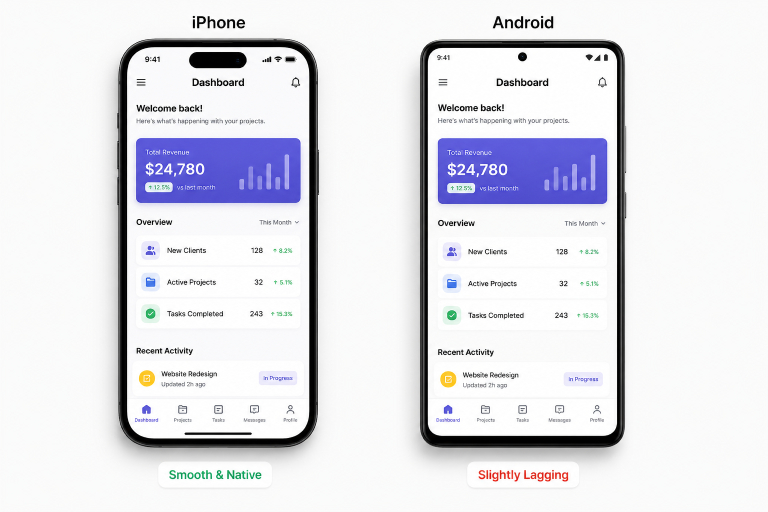
Introduction – The App Development Dilemma
Mobile applications continue to be essential growth drivers for startups in 2026. As digital competition increases across industries, businesses are under pressure to launch fast, scalable, and user-friendly applications that deliver seamless experiences across both iOS and Android platforms.
One of the most important decisions startups face is choosing between native vs cross platform app development. This decision directly impacts development costs, user experience, application performance, scalability, maintenance requirements, and long-term business growth.
Native applications are developed specifically for a single platform using platform-specific technologies such as Swift for iOS and Kotlin for Android. Cross-platform development, on the other hand, enables developers to create a unified codebase that works across multiple operating systems.
With AI-assisted development, faster deployment cycles, and increasingly sophisticated frameworks available in 2026, startups have more options than ever before. While cross-platform frameworks offer faster time-to-market and reduced development costs, native applications continue to lead in performance-intensive environments.
Understanding the strengths and limitations of each approach is essential before investing in mobile app development. The right decision depends on business objectives, product complexity, audience expectations, budget, and future scalability requirements.
This guide explores the complete comparison between native and cross-platform development approaches to help startups choose the most suitable solution for 2026 and beyond.
What is Native App Development?
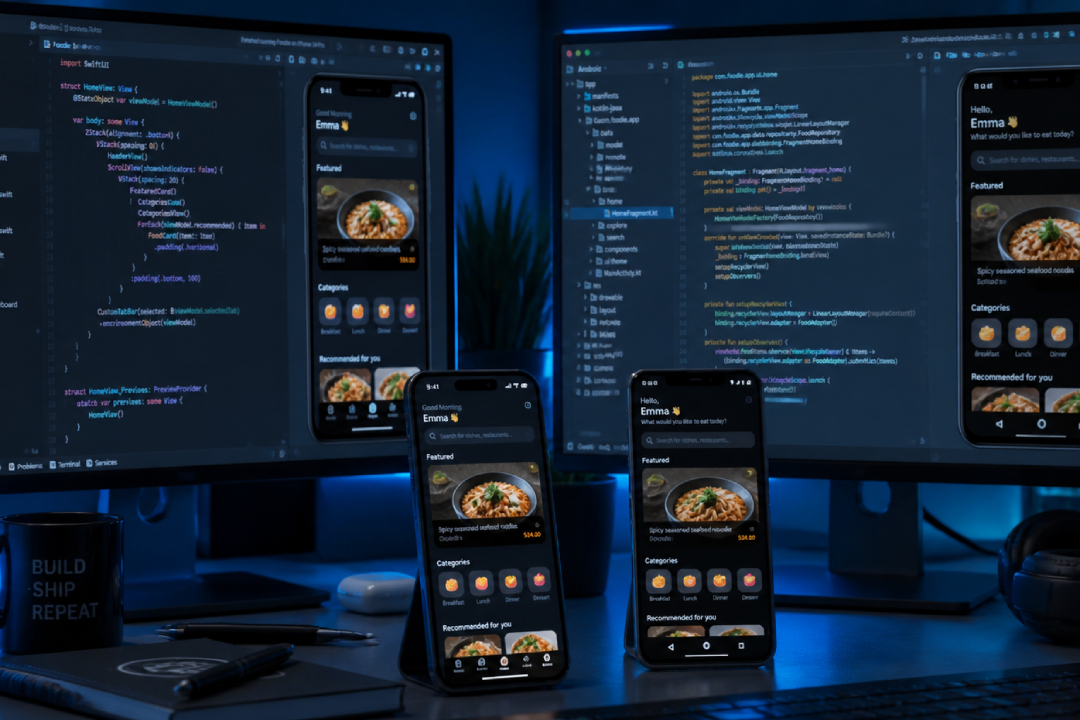
Native app development refers to building applications specifically for a single operating system using platform-native programming languages, tools, and frameworks. For iOS development, teams commonly use Swift and Xcode, while Android applications are typically developed using Kotlin and Android Studio.
Native applications are optimized directly for their target operating systems. This allows developers to leverage platform-specific APIs, hardware capabilities, security frameworks, and operating system features without compromise.
As a result, native apps typically offer:
- Superior performance
- Smoother animations
- Faster load times
- Enhanced responsiveness
- Better system integration
Businesses prioritizing speed, reliability, and premium user experiences often choose native development. Industries such as fintech, healthcare, logistics, gaming, and AI-powered platforms frequently rely on native architectures to support demanding functionality.
One of the biggest advantages of native development is seamless access to advanced device capabilities, including:
- GPS
- Camera systems
- Bluetooth connectivity
- Push notifications
- Biometric authentication
- NFC technology
- Device sensors and accelerometers
- AR and spatial computing features
Native development also ensures closer adherence to platform-specific design standards established by Apple and Google. This results in highly intuitive user experiences that feel natural on each operating system.
However, native development requires maintaining separate codebases for iOS and Android, increasing:
- Development costs
- Engineering resources
- Testing requirements
- Maintenance efforts
For startups with limited budgets or aggressive launch timelines, these factors can become significant challenges.
Despite higher investment requirements, native development remains the preferred choice for businesses requiring:
- High-performance applications
- Advanced security systems
- Complex animations
- Real-time processing
- Enterprise-grade scalability
- Heavy graphics rendering
- Immersive AR/VR experiences
In the ongoing discussion around native vs cross platform app development, native applications continue to dominate use cases where performance and user experience directly influence business success.
What is Cross-Platform Development?
Cross-platform development is an approach that allows developers to build a single application codebase that runs across multiple operating systems, including iOS and Android. Instead of creating separate applications for each platform, businesses can streamline development using shared technologies and frameworks.
This approach has become increasingly popular in 2026 due to improvements in framework performance, AI-assisted coding tools, and faster deployment workflows.
Startups often prefer cross-platform development because it enables:
- Reduced development costs
- Faster time-to-market
- Simplified maintenance
- Broader platform reach
- Consistent branding across devices
Leading cross-platform frameworks in 2026 include Flutter, React Native, Ionic, and .NET MAUI. These technologies provide reusable components, native integrations, and optimized rendering engines that support modern application development.
One of the biggest advantages of cross-platform development is operational efficiency. Businesses can:
- Reuse most application code
- Reduce engineering overhead
- Accelerate product launches
- Simplify feature rollouts
- Improve maintenance workflows
Cross-platform development is particularly valuable for startups seeking rapid MVP launches, market validation, and cost-effective scaling strategies.
Modern frameworks have significantly improved performance compared to previous generations. Applications built with Flutter and React Native now deliver near-native experiences for many business use cases.
However, certain limitations still exist. Cross-platform applications may encounter challenges involving:
- Graphics-intensive workloads
- Advanced hardware integrations
- Platform-specific optimizations
- Complex animation systems
- Ultra-low latency processing
In some scenarios, developers may need to create native modules to support specialized functionality.
Even with these limitations, cross-platform development remains one of the fastest-growing mobile app strategies in 2026. For startups focused on efficiency, scalability, and rapid deployment, cross-platform frameworks provide a highly practical solution.
Detailed Comparison Table
When evaluating native vs cross platform app development, startups should assess factors beyond development cost alone. Performance, user experience, maintenance complexity, scalability, and long-term operational efficiency all play important roles in determining success.
― Performance
Native applications generally deliver the highest level of performance because they are optimized directly for the target operating system. They provide faster rendering, smoother animations, and superior responsiveness.
Cross-platform frameworks have improved significantly in recent years, especially Flutter and React Native. However, performance differences may still become noticeable in highly demanding applications.
Native Development:
- Maximum performance optimization
- Superior rendering efficiency
- Better hardware utilization
- Ideal for gaming, fintech, and AI applications
Cross-Platform Development:
- Near-native performance for most applications
- Efficient for standard business use cases
- Slight limitations in performance-intensive environments
― Cost
Cost remains one of the most influential factors for startup decision-making.
Native development typically requires separate iOS and Android engineering resources, increasing development and maintenance expenses.
Native Development:
- Higher initial investment
- Separate development teams
- Higher QA and testing costs
Cross-Platform Development:
- Lower development expenses
- Shared codebase efficiency
- Reduced maintenance costs
― Time to Market
Speed is critical for startups seeking market validation and investor traction.
Cross-platform development enables simultaneous deployment across platforms, significantly reducing launch timelines.
Native Development:
- Longer development cycles
- Separate platform releases
- Slower feature deployment
Cross-Platform Development:
- Faster MVP launches
- Simultaneous deployment
- Rapid iteration cycles
― User Experience
Native applications generally provide the most refined user experience because they fully align with platform-specific design guidelines.
Native Development:
- Superior responsiveness
- Optimized platform-specific interactions
- Advanced animation capabilities
Cross-Platform Development:
- Consistent experience across devices
- Strong usability for most applications
- Minor limitations in highly customized interfaces
― Maintenance
Maintenance complexity increases as applications evolve and scale.
Native Development:
- Separate maintenance workflows
- Higher engineering overhead
- More complex update cycles
Cross-Platform Development:
- Unified maintenance structure
- Simplified feature deployment
- Lower operational complexity
For many startups, the optimal choice depends on balancing mobile app development cost, scalability goals, product complexity, and long-term growth plans.
When to Choose Native
Native development is the preferred option when performance, scalability, security, and user experience are business-critical priorities. Applications requiring deep hardware integration or intensive processing typically benefit significantly from native architectures.
Applications involving:
- Real-time communication
- AI-powered functionality
- Advanced cybersecurity features
- AR/VR experiences
- High-end gaming
- Enterprise-grade mobility solutions
often require native optimization for maximum effectiveness.
Startups operating in industries such as fintech, healthcare, logistics, and gaming frequently choose native development because superior performance directly influences user retention and satisfaction.
Native development is also ideal when businesses require highly customized interfaces that fully align with Apple and Google design standards.
Businesses should consider native development if:
- User experience is mission-critical
- Advanced hardware integration is required
- Security and compliance are priorities
- Performance-intensive functionality is involved
- Long-term scalability is essential
- Sufficient budget is available
Although native development requires higher investment, it often delivers exceptional long-term reliability, performance, and customer satisfaction.
For startups building premium digital products, native development remains one of the strongest choices in 2026.
Top Cross-Platform Frameworks 2026
― Flutter (Google)
Flutter continues to be one of the most dominant cross-platform frameworks in 2026, thanks to its powerful rendering engine, extensive widget library, and strong support for mobile, web, and desktop applications. Developed by Google, Flutter uses Dart and enables developers to create visually rich, high-performance applications from a single codebase.
Flutter is particularly popular among startups and enterprises seeking fast development cycles combined with highly customized user experiences.
Strengths:
- Excellent performance with near-native execution
- Rich and customizable UI components
- Consistent experience across platforms
- Strong ecosystem and community support
- Support for mobile, web, and desktop applications
Flutter remains a leading choice in react native vs flutter 2026 discussions because of its design flexibility, scalability, and growing enterprise adoption.
― React Native (Meta)
React Native remains one of the most widely adopted frameworks for cross-platform mobile app development in 2026. Backed by Meta and supported by a large developer community, React Native enables businesses to leverage JavaScript and React expertise for mobile application development.
Recent improvements in architecture, rendering performance, and native interoperability have strengthened React Native’s position among startups and enterprises.
Strengths:
- Large JavaScript ecosystem
- Faster development workflows
- Reusable components and code
- Strong community and plugin ecosystem
- Efficient integration with existing React web applications
React Native remains ideal for startups already investing in React-based web development and seeking unified development workflows.
― Ionic
Ionic continues to serve businesses looking to build mobile applications using familiar web technologies such as HTML, CSS, and JavaScript. It provides an efficient development environment for organizations prioritizing speed and cost-efficiency.
Although Flutter and React Native generally offer stronger performance, Ionic remains relevant for content-driven applications, internal enterprise tools, and business management systems.
Strengths:
- Rapid development process
- Strong compatibility with web technologies
- Lower learning curve for web developers
- Cost-effective implementation
- Efficient enterprise application development
― .NET MAUI (Microsoft)
By 2026, .NET MAUI has largely replaced Xamarin as Microsoft’s primary cross-platform development framework. It enables developers to build applications for Android, iOS, Windows, and macOS using C# and the .NET ecosystem.
Organizations already invested in Microsoft technologies increasingly choose .NET MAUI for enterprise-grade applications and business solutions.
Strengths:
- Unified development across multiple platforms
- Strong Microsoft ecosystem integration
- Access to native platform APIs
- Enterprise-grade scalability
- Long-term Microsoft support
Each framework offers unique benefits, and the ideal choice depends on business objectives, team expertise, scalability requirements, and long-term product strategy.
Cost Analysis: Real Numbers
Understanding mobile app development cost remains critical for startups planning digital product investments in 2026.
Native development generally requires dedicated engineering resources for iOS and Android platforms. While development tools have become more efficient with AI-assisted coding and automation, native applications still involve higher overall investment.
Typical native app development costs:
- Basic startup app: $30,000 – $60,000 per platform
- Medium-complexity application: $70,000 – $140,000
- Enterprise-grade application: $180,000+
Cross-platform development typically reduces costs by approximately 30% to 50% because teams maintain a shared codebase and streamline development workflows.
Estimated cross-platform development costs:
- MVP applications: $20,000 – $50,000
- Mid-scale business apps: $60,000 – $100,000
- Enterprise applications: $120,000+
Additional factors affecting development cost include:
- UI/UX complexity
- AI and machine learning integration
- Third-party API integrations
- Cloud infrastructure requirements
- Cybersecurity implementation
- Backend scalability requirements
- Ongoing maintenance and support
Maintenance costs also play an important role in total ownership expenses. Native applications generally require separate testing, updates, and platform-specific maintenance cycles.
Cross-platform applications simplify maintenance and deployment workflows, helping startups reduce long-term operational expenses.
For startups prioritizing rapid growth and efficient resource allocation, cross-platform development often delivers stronger early-stage ROI. However, applications requiring advanced graphics, real-time processing, or intensive hardware integration may justify native development investments.
Ultimately, businesses should evaluate long-term strategic goals rather than focusing exclusively on upfront development costs.
Developer Infotech Case Studies
Developer Infotech has successfully delivered scalable mobile applications using both native and cross-platform technologies across multiple industries.
For a fast-growing eCommerce startup, the team developed a Flutter-based cross-platform application that enabled simultaneous deployment on iOS and Android. The approach reduced development timelines significantly while maintaining a consistent and engaging user experience.
In another project, Developer Infotech created a native fintech application requiring advanced biometric authentication, real-time transaction processing, regulatory compliance, and enhanced security controls. Native development enabled superior performance and reliability for critical financial operations.
The company has also delivered React Native and Flutter solutions for:
- SaaS startups
- Healthcare platforms
- Logistics and delivery management systems
- Social networking applications
- Enterprise productivity tools
- Subscription-based digital platforms
Developer Infotech combines expertise in:
- Mobile App Development
- UI/UX Design
- AI Solutions
- Web Development
- Laravel Development
- Shopify Development
- Custom Software Development
Every project begins with detailed business analysis to identify the most suitable architecture based on performance goals, scalability requirements, target audience, budget, and timeline expectations.
By aligning technology decisions with business objectives, Developer Infotech helps startups and enterprises build future-ready applications designed for sustainable growth and competitive advantage.
Final Recommendations
Choosing between native vs cross platform app development depends on your startup’s goals, budget, technical requirements, and long-term vision.
Native development remains the preferred choice for businesses requiring maximum performance, advanced hardware access, enterprise-grade security, and highly optimized user experiences. While the initial investment is higher, native applications continue to offer superior control, responsiveness, and scalability.
Cross-platform development remains an excellent option for startups seeking faster launches, lower development costs, and efficient maintenance. Modern frameworks such as Flutter, React Native, and .NET MAUI have significantly narrowed the performance gap, making them viable solutions for many commercial applications.
For MVP launches, startup validation, and budget-conscious growth strategies, cross-platform development often provides the best balance between speed, cost efficiency, and scalability. Businesses developing highly specialized or performance-intensive applications may benefit more from native architecture.
The most important consideration is selecting a development strategy that aligns with long-term business goals rather than focusing solely on short-term cost savings.
Developer Infotech helps startups evaluate the right architecture, frameworks, and development approaches to create scalable digital products that support growth in 2026 and beyond. With expertise in mobile app development, UI/UX design, AI solutions, and custom software development, the team delivers modern applications built for long-term success in an increasingly competitive digital landscape.