How to Build a High-Converting E-commerce Website in 2025: Complete Guide
Introduction – E-commerce Boom in India
India’s e-commerce industry is experiencing unprecedented growth in 2025. Rapid smartphone adoption, affordable internet access, digital payment systems, and changing consumer behavior have transformed how businesses sell products online. From startups and D2C brands to large enterprises, companies across industries are investing heavily in ecommerce website development 2025 strategies to capture growing digital demand.
Modern consumers expect fast-loading websites, seamless mobile experiences, secure payments, personalized recommendations, and frictionless checkout systems. Businesses that fail to deliver optimized online shopping experiences risk losing customers to competitors offering more convenient digital platforms.
At the same time, the Indian e-commerce ecosystem has become highly competitive. Building a successful online store now requires more than attractive design alone. Businesses must combine performance, scalability, SEO optimization, conversion-focused UI/UX, advanced analytics, and AI-powered customer experiences to achieve long-term growth.
Whether launching a Shopify store, WooCommerce website, Magento marketplace, or custom ecommerce platform, selecting the right technology stack and development strategy is essential for success.
This guide explores the latest ecommerce best practices, platform comparisons, conversion optimization strategies, development costs, SEO techniques, and security standards businesses need to build high-performing e-commerce websites in 2025.
E-commerce Platform Comparison 2025
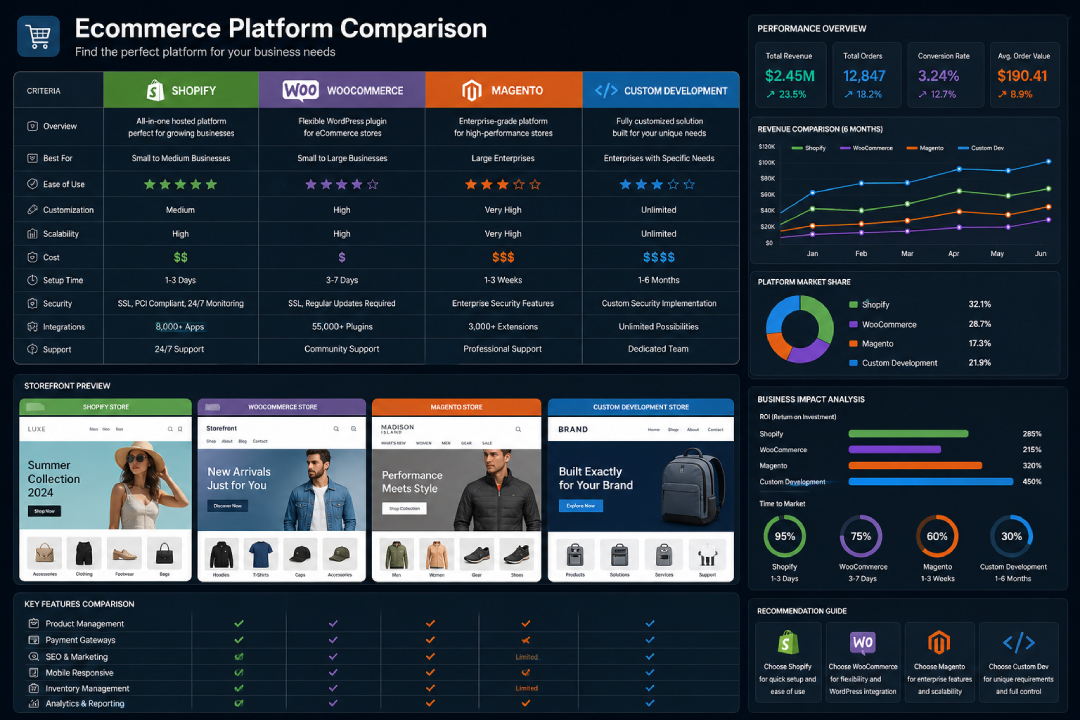
Choosing the right platform is one of the most important decisions in ecommerce website development 2025. Every platform offers different strengths in scalability, customization, performance, and operational flexibility. Businesses must evaluate technical requirements, budget, growth goals, and long-term maintenance before selecting the ideal ecommerce solution.
― Shopify
Shopify remains one of the most popular ecommerce platforms globally due to its simplicity, scalability, and fast deployment capabilities. It is particularly suitable for startups, small businesses, and rapidly growing D2C brands.
Shopify provides:
- Hosted infrastructure
- Easy product management
- Secure payment integrations
- Mobile optimization
- App ecosystem support
- Built-in hosting and security
One of Shopify’s biggest advantages is speed to market. Businesses can launch online stores quickly without managing servers or complex backend systems.
Shopify also supports:
- Multi-channel selling
- Inventory management
- AI-powered automation
- Advanced analytics
- Subscription commerce
However, Shopify has limitations in deep customization and may involve higher recurring costs due to app subscriptions and transaction fees.
It remains an excellent choice for businesses prioritizing:
- Fast store launches
- Simplified maintenance
- Scalability
- Strong mobile commerce
- Easy operational management
Shopify Development continues to dominate the growing D2C ecommerce landscape in India.
― WooCommerce
WooCommerce is a highly flexible ecommerce plugin built for WordPress websites. It is widely adopted because of its customization flexibility, large plugin ecosystem, and cost-effective setup.
Businesses looking for complete design and development control often prefer WooCommerce.
Key advantages include:
- Open-source flexibility
- Extensive plugin support
- Strong SEO capabilities
- Lower upfront costs
- Easy WordPress integration
- Full content management control
WooCommerce is especially suitable for:
- Content-driven ecommerce websites
- SEO-focused stores
- Medium-sized businesses
- Brands requiring custom workflows
Because WooCommerce runs on WordPress, businesses can combine ecommerce functionality with blogging, landing pages, and content marketing strategies efficiently.
However, WooCommerce requires:
- Hosting management
- Security maintenance
- Plugin updates
- Performance optimization
Without proper development practices, WooCommerce stores may experience scalability challenges under heavy traffic conditions.
In the ongoing shopify vs woocommerce vs magento comparison, WooCommerce stands out for flexibility and content-driven ecommerce strategies.
― Magento / Adobe Commerce
Magento, now known as Adobe Commerce, is a powerful enterprise ecommerce platform designed for large-scale businesses and complex online marketplaces.
Magento offers advanced capabilities such as:
- Multi-store management
- Enterprise-level scalability
- Advanced product catalog systems
- Complex inventory management
- B2B ecommerce functionality
- Custom pricing structures
Large enterprises choose Magento because of its ability to handle massive product inventories and highly customized ecommerce workflows.
Magento is ideal for:
- Enterprise ecommerce platforms
- Large marketplaces
- International ecommerce businesses
- Complex inventory systems
- High-volume online stores
However, Magento development requires highly skilled developers and stronger hosting infrastructure. Development costs and maintenance expenses are also significantly higher compared to Shopify and WooCommerce.
Despite higher investment requirements, Magento remains one of the most scalable ecommerce solutions available in 2025.
― Custom Development
Custom ecommerce development provides complete flexibility for businesses requiring highly specialized functionality, advanced integrations, or unique user experiences.
Unlike template-based platforms, custom development allows businesses to create tailored ecommerce ecosystems using technologies such as:
- Laravel
- React.js
- Next.js
- Node.js
- Custom APIs
- AI integrations
Custom development is often preferred for:
- Enterprise marketplaces
- AI-powered ecommerce
- Subscription commerce platforms
- Large-scale D2C ecosystems
- Multi-vendor platforms
Major advantages include:
- Unlimited scalability
- Full UI/UX customization
- Advanced integrations
- Better performance optimization
- Flexible architecture
However, custom development involves:
- Higher development costs
- Longer timelines
- Dedicated maintenance
- Technical expertise requirements
For businesses seeking complete digital ownership and long-term scalability, custom ecommerce development provides unmatched flexibility and performance.
Must-Have Features for 2025
Modern ecommerce websites must go beyond basic functionality to remain competitive in 2025. Customer expectations continue to evolve rapidly, requiring businesses to implement intelligent, user-focused, and conversion-driven features.
― Mobile-First Design
Mobile commerce dominates online shopping behavior in India. Businesses must prioritize responsive design, fast mobile loading speeds, and seamless smartphone experiences.
Mobile-first ecommerce websites should include:
- Responsive layouts
- Touch-friendly navigation
- Fast-loading product pages
- Optimized mobile checkout
- Mobile payment integration
A poor mobile experience can significantly increase bounce rates and cart abandonment.
― Fast Checkout
Checkout optimization is one of the most important ecommerce best practices for increasing conversions.
Modern customers expect:
- One-page checkout
- Guest checkout options
- Autofill capabilities
- Multiple payment methods
- Fast transaction processing
Reducing checkout friction directly improves conversion rates and customer retention.
― AI Recommendations
AI-powered personalization has become essential in ecommerce website development 2025 strategies.
AI recommendation systems analyze:
- Browsing behavior
- Purchase history
- Customer preferences
- Product interactions
This allows businesses to display:
- Personalized products
- Dynamic upselling
- Cross-selling suggestions
- Smart search results
AI-driven personalization improves customer engagement and increases average order value.
― Multiple Payment Gateways
Indian consumers use diverse payment methods, making payment flexibility critical for ecommerce success.
Modern ecommerce websites should support:
- UPI payments
- Credit and debit cards
- Net banking
- Wallet payments
- Buy now pay later solutions
- International payment systems
Secure and flexible payment infrastructure improves trust and reduces transaction failures.
― Advanced Analytics
Data-driven decision-making is essential for ecommerce growth.
Advanced analytics systems help businesses monitor:
- User behavior
- Sales performance
- Traffic sources
- Conversion funnels
- Cart abandonment
- Customer lifetime value
Integrating analytics tools enables continuous optimization and smarter marketing decisions.
Modern ecommerce stores also benefit from:
- AI-powered reporting
- Heatmap analysis
- Predictive customer insights
- Automated inventory forecasting
Businesses investing in intelligent ecommerce features gain stronger competitive advantages in customer acquisition and retention.
Conversion Optimization Strategies
Building an ecommerce website is only the first step. Long-term success depends on optimizing the store for maximum conversions and customer retention.
One of the most effective strategies is improving website speed. Slow-loading ecommerce websites increase bounce rates and reduce customer trust. Businesses should optimize:
- Image compression
- Caching systems
- CDN integration
- Code efficiency
- Server performance
Clear navigation is equally important. Customers should easily find products using:
- Smart search systems
- Category filters
- Predictive search
- Product recommendations
Product pages must also focus heavily on conversion optimization. High-converting product pages typically include:
- Professional product images
- Product videos
- Customer reviews
- Clear pricing
- Trust indicators
- Strong call-to-action buttons
Trust-building elements significantly impact purchase decisions. Businesses should display:
- SSL certificates
- Secure payment badges
- Return policies
- Delivery timelines
- Customer testimonials
Personalization is another major ecommerce best practice in 2025. AI-driven personalization helps businesses create highly targeted shopping experiences based on customer behavior and preferences.
Cart abandonment recovery strategies are also critical. Businesses can recover lost revenue using:
- Automated email reminders
- Exit-intent popups
- Retargeting campaigns
- Discount incentives
UI/UX design plays a major role in conversion optimization. Clean layouts, intuitive navigation, and frictionless user experiences improve engagement and customer satisfaction.
Successful ecommerce brands continuously test:
- CTA placements
- Product page layouts
- Checkout flows
- Homepage banners
- Promotional messaging
Continuous optimization ensures better customer experiences and improved sales performance over time.
Development Cost Breakdown
Understanding ecommerce development cost india is essential for businesses planning digital commerce investments in 2025.
Development costs vary significantly depending on:
- Platform selection
- Design complexity
- Feature requirements
- Third-party integrations
- Scalability expectations
- Security requirements
― Shopify Development Costs
Basic Shopify stores typically cost between ₹50,000 and ₹2,50,000 depending on customization levels.
Advanced Shopify stores with:
- Custom UI/UX
- Subscription systems
- ERP integrations
- AI features
- Multi-vendor functionality
can cost significantly more.
Additional recurring costs include:
- Shopify subscriptions
- App licenses
- Payment gateway fees
- Maintenance services
― WooCommerce Development Costs
WooCommerce development is generally more affordable initially.
Typical costs include:
- Hosting
- Theme customization
- Plugin development
- Security optimization
- SEO implementation
Medium-sized WooCommerce projects often range from ₹80,000 to ₹5,00,000 depending on complexity.
― Magento Development Costs
Magento is one of the most expensive ecommerce platforms due to enterprise-level capabilities.
Development costs often include:
- Dedicated hosting infrastructure
- Enterprise licensing
- Custom module development
- Security optimization
- Performance scaling
Large Magento projects may exceed ₹10,00,000 or more for enterprise businesses.
― Custom Ecommerce Development Costs
Custom online store development offers maximum flexibility but also involves higher investment.
Custom ecommerce solutions typically include:
- UI/UX design
- Frontend development
- Backend development
- API integrations
- AI implementation
- Mobile app integration
- Cloud infrastructure
Development costs can range from ₹3,00,000 to ₹25,00,000+ depending on scalability and complexity.
Long-term maintenance, SEO optimization, server management, and security monitoring should also be included in overall ecommerce budgeting strategies.
SEO for E-commerce
SEO remains one of the most important growth drivers for ecommerce businesses in 2025. Organic search traffic delivers long-term visibility, lower acquisition costs, and sustainable customer growth.
Successful ecommerce SEO strategies begin with optimized website architecture. Product categories, URLs, navigation structures, and internal linking systems must be designed for both search engines and users.
Keyword optimization remains important, but modern ecommerce SEO focuses heavily on:
- Search intent
- User experience
- Page performance
- Mobile usability
- Content quality
Product pages should include:
- Optimized product titles
- SEO-friendly descriptions
- Structured data markup
- High-quality images
- Customer reviews
- FAQ content
Technical SEO is equally critical for ecommerce website development 2025 success.
Businesses should optimize:
- Core Web Vitals
- Mobile responsiveness
- XML sitemaps
- Crawlability
- Canonical tags
- Page indexing
Content marketing also plays a major role in ecommerce growth. Blogs, buying guides, product comparisons, and educational content improve organic visibility and customer trust.
AI-driven search algorithms increasingly prioritize:
- User engagement
- Helpful content
- Fast-loading pages
- Secure browsing
- Personalized experiences
Local SEO has also become important for Indian ecommerce businesses targeting regional markets and multilingual audiences.
Strong SEO implementation improves:
- Organic traffic
- Brand visibility
- Conversion rates
- Customer trust
- Long-term ROI
Businesses investing in SEO-focused online store development gain significant competitive advantages in crowded ecommerce markets.
Security Considerations
Security is one of the most critical aspects of ecommerce website development 2025. Customers expect safe transactions, secure payment processing, and protected personal information.
Modern ecommerce websites must implement strong security protocols to prevent:
- Data breaches
- Payment fraud
- Malware attacks
- Account takeovers
- Unauthorized access
SSL encryption is essential for protecting customer data during transactions. Businesses should also implement:
- Secure payment gateways
- Two-factor authentication
- Regular security audits
- Firewall protection
- Malware monitoring
PCI DSS compliance is important for websites handling payment information.
Businesses should also prioritize:
- Secure hosting infrastructure
- Automated backups
- Role-based admin access
- API security
- Real-time threat monitoring
AI-powered fraud detection systems are becoming increasingly popular in ecommerce ecosystems. These tools help identify suspicious activity and reduce fraudulent transactions.
Customer trust depends heavily on website security. A secure ecommerce platform improves brand credibility, protects sensitive information, and reduces financial risk.
As cyber threats continue evolving, ecommerce businesses must adopt proactive security strategies rather than reactive approaches.
Developer Infotech E-commerce Services
Developer Infotech provides scalable and conversion-focused ecommerce solutions tailored for modern businesses in 2025. The company helps startups, D2C brands, and enterprises build secure, high-performing, and SEO-optimized ecommerce platforms designed for long-term growth.
Services include:
- Shopify Development
- WooCommerce Development
- Magento Development
- Custom Ecommerce Development
- UI/UX Design
- Mobile App Development
- Laravel Development
- AI Solutions
- Custom Software Development
Developer Infotech focuses on building ecommerce ecosystems that combine:
- High performance
- Conversion optimization
- Mobile-first experiences
- Advanced analytics
- AI-powered personalization
- Secure payment infrastructure
The development process includes strategic planning, platform selection, UI/UX optimization, SEO implementation, performance enhancement, and long-term scalability planning.
Whether businesses require a simple online store or a complex enterprise marketplace, Developer Infotech delivers tailored ecommerce solutions aligned with business objectives and customer expectations.
By combining modern technologies, ecommerce best practices, and business-focused development strategies, Developer Infotech helps brands create powerful digital commerce experiences that drive measurable growth and customer engagement.