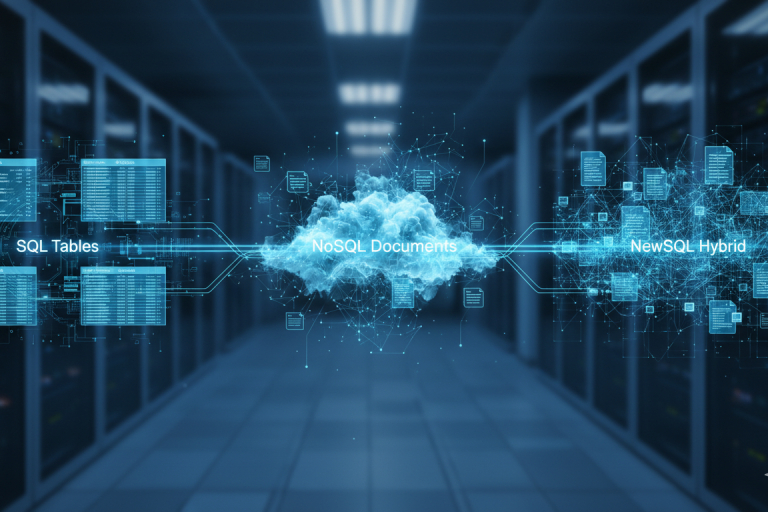
Introduction – Database Landscape
Modern applications generate and process enormous volumes of data across web platforms, ecommerce ecosystems, SaaS products, AI-powered applications, IoT environments, and enterprise systems. As digital infrastructures become increasingly distributed and data-intensive, selecting the right database architecture has become one of the most important technology decisions organizations face.
The discussion around sql vs nosql vs newsql 2026 reflects the growing demand for scalable, resilient, cloud-native, and high-performance database systems capable of supporting modern workloads.
Traditional relational databases continue to power transactional systems, enterprise software, and business-critical applications. NoSQL platforms offer flexibility and scalability for rapidly evolving applications, while NewSQL databases are gaining popularity by combining SQL consistency with distributed cloud-native scalability.
Organizations evaluating a modern database selection guide must consider performance requirements, scalability goals, consistency models, infrastructure complexity, operational costs, AI readiness, and long-term business growth.
Developer Infotech helps organizations design scalable data architectures through Laravel Development, Web Development, AI Solutions, Mobile App Development, and enterprise-grade Custom Software Development services optimized for modern digital ecosystems.
Relational Databases (SQL)
Relational databases remain the foundation of enterprise software systems and transactional applications worldwide. SQL databases organize data into structured tables with predefined schemas, providing strong consistency, data integrity, and reliable transaction processing.
Popular SQL databases include PostgreSQL, MySQL, Microsoft SQL Server, Oracle Database, and cloud-native managed relational services.
One of the most significant advantages of SQL systems is ACID compliance, which ensures data accuracy, consistency, isolation, and durability during transactions.
This makes relational databases ideal for financial platforms, ecommerce systems, ERP solutions, healthcare applications, government systems, and enterprise software where transactional reliability is essential.
SQL databases also provide powerful querying capabilities through Structured Query Language (SQL).
Developers can efficiently perform complex joins, aggregations, filtering, reporting, and analytical operations across related datasets.
Modern enterprises continue to rely heavily on SQL systems for operational workflows, compliance reporting, business intelligence, and transactional processing.
Another major advantage is ecosystem maturity.
SQL databases integrate seamlessly with frameworks such as Laravel, Django, Spring Boot, .NET, and enterprise backend platforms.
In discussions around postgresql vs mongodb, PostgreSQL is often preferred for applications requiring strong consistency, relational integrity, advanced indexing, and sophisticated querying capabilities.
While traditional SQL databases historically faced scalability limitations, modern relational systems have evolved significantly.
Today’s SQL platforms support replication, partitioning, clustering, distributed storage, read replicas, and cloud-native scaling strategies.
Managed cloud database services further simplify administration while improving availability, security, backup management, and disaster recovery.
Developer Infotech builds scalable SQL-powered systems for enterprise software platforms, ecommerce ecosystems, SaaS products, and business-critical applications requiring high transactional reliability.
NoSQL Databases
NoSQL databases were designed to address the scalability, flexibility, and distributed architecture requirements that traditional relational databases sometimes struggle to support.
Unlike SQL databases, NoSQL platforms support flexible schemas and are optimized for large-scale, distributed workloads.
Modern nosql database types include document databases, key-value stores, column-oriented databases, and graph databases.
These platforms are particularly well suited for applications managing large volumes of semi-structured, unstructured, or rapidly changing data.
― Document Databases (MongoDB)
Document databases store data using flexible JSON-like structures rather than rigid relational schemas.
MongoDB remains one of the most widely adopted document-oriented NoSQL databases in 2026.
Its schema flexibility allows development teams to modify application structures without complex migrations or database redesigns.
This makes MongoDB highly effective for content management systems, ecommerce catalogs, AI applications, customer portals, mobile apps, and rapidly evolving SaaS products.
In modern postgresql vs mongodb comparisons, MongoDB is often preferred for projects requiring agility, schema flexibility, rapid development, and horizontal scalability.
Document databases also align well with API-driven architectures and modern frontend frameworks.
― Key-Value Databases (Redis)
Key-value databases store information as simple key-value pairs optimized for extremely fast retrieval and low-latency operations.
Redis continues to play a critical role in caching, session management, real-time analytics, queue processing, AI inference acceleration, and event-driven architectures.
Its in-memory design delivers exceptional performance and responsiveness.
Modern cloud-native applications frequently use Redis to reduce database load, improve scalability, and enhance user experiences.
― Column Databases (Cassandra)
Column-oriented NoSQL databases are optimized for distributed storage, large-scale workloads, and high write performance.
Apache Cassandra remains one of the most widely used distributed column databases.
It provides fault tolerance, high availability, and horizontal scalability across multiple nodes, regions, and cloud environments.
Cassandra is frequently deployed in IoT ecosystems, telemetry platforms, analytics infrastructures, streaming applications, and large-scale enterprise environments.
― Graph Databases (Neo4j)
Graph databases specialize in managing relationships between entities.
Neo4j remains a leading graph database platform used for fraud detection, recommendation engines, social networks, supply chain analysis, cybersecurity modeling, and knowledge graph applications.
Graph databases excel at traversing complex interconnected datasets efficiently.
As AI-powered personalization, recommendation systems, and relationship-based analytics continue expanding, graph databases are becoming increasingly valuable.
NoSQL platforms offer substantial advantages in flexibility, scalability, performance, and distributed architecture support.
However, organizations must carefully evaluate trade-offs related to consistency models, transaction requirements, governance, and operational complexity.
Developer Infotech helps businesses implement scalable NoSQL infrastructures optimized for AI systems, real-time applications, ecommerce platforms, cloud-native environments, and enterprise ecosystems.
NewSQL Databases
NewSQL databases aim to combine the strengths of traditional relational databases with the scalability and resilience of distributed cloud-native architectures.
These platforms maintain SQL compatibility and ACID compliance while supporting horizontal scaling and geographically distributed deployments.
Popular NewSQL solutions include CockroachDB, Google Spanner, TiDB, and YugabyteDB.
One of the greatest advantages of NewSQL is distributed consistency.
Unlike many traditional NoSQL systems, NewSQL databases preserve strong transactional guarantees while operating across multiple nodes and regions.
This makes them highly suitable for fintech applications, global SaaS products, ecommerce platforms, payment systems, and mission-critical enterprise software.
NewSQL architectures also support modern cloud deployment strategies through built-in replication, fault tolerance, geo-distribution, and automated recovery mechanisms.
As organizations continue modernizing digital infrastructures, NewSQL adoption is growing rapidly in discussions around sql vs nosql vs newsql 2026.
However, NewSQL platforms may introduce greater operational complexity than conventional relational systems.
Successful adoption often requires expertise in distributed systems, cloud infrastructure, DevOps practices, and database operations.
Developer Infotech helps organizations implement scalable NewSQL architectures optimized for cloud-native applications, enterprise growth, and globally distributed environments.
Database Comparison Matrix
Modern database selection depends on workload requirements, scalability objectives, data complexity, consistency expectations, and operational requirements.
SQL databases provide strong consistency, relational integrity, mature tooling, advanced reporting capabilities, and powerful analytical querying. They remain ideal for structured transactional systems, enterprise software, financial applications, and business-critical workloads.
NoSQL databases prioritize flexibility, scalability, and distributed performance.
Document databases support dynamic schemas and rapidly evolving applications. Key-value databases deliver ultra-fast caching and real-time processing. Column-oriented databases excel in distributed workloads and high-volume data ingestion. Graph databases efficiently manage relationship-driven datasets and interconnected systems.
NewSQL platforms bridge the gap between traditional SQL consistency and modern distributed scalability.
They offer SQL compatibility, ACID compliance, and horizontal scaling while supporting cloud-native deployments and globally distributed architectures.
From a scalability perspective, NoSQL and NewSQL platforms generally provide stronger native support for distributed systems than traditional monolithic SQL deployments.
However, modern SQL databases continue to evolve through clustering, sharding, replication, partitioning, and cloud-native scaling technologies.
In modern database architecture planning, organizations increasingly adopt multiple database technologies based on workload requirements.
For example:
- SQL databases for transactional processing
- Redis for caching and session management
- MongoDB for dynamic application data
- Cassandra for analytics and large-scale data ingestion
- Neo4j for recommendation engines and relationship analysis
- NewSQL platforms for globally distributed transactional workloads
This approach, often referred to as polyglot persistence, improves scalability, flexibility, and performance across complex digital ecosystems.
Developer Infotech designs scalable hybrid database architectures optimized for enterprise software systems, ecommerce platforms, SaaS products, AI applications, and cloud-native digital infrastructures.
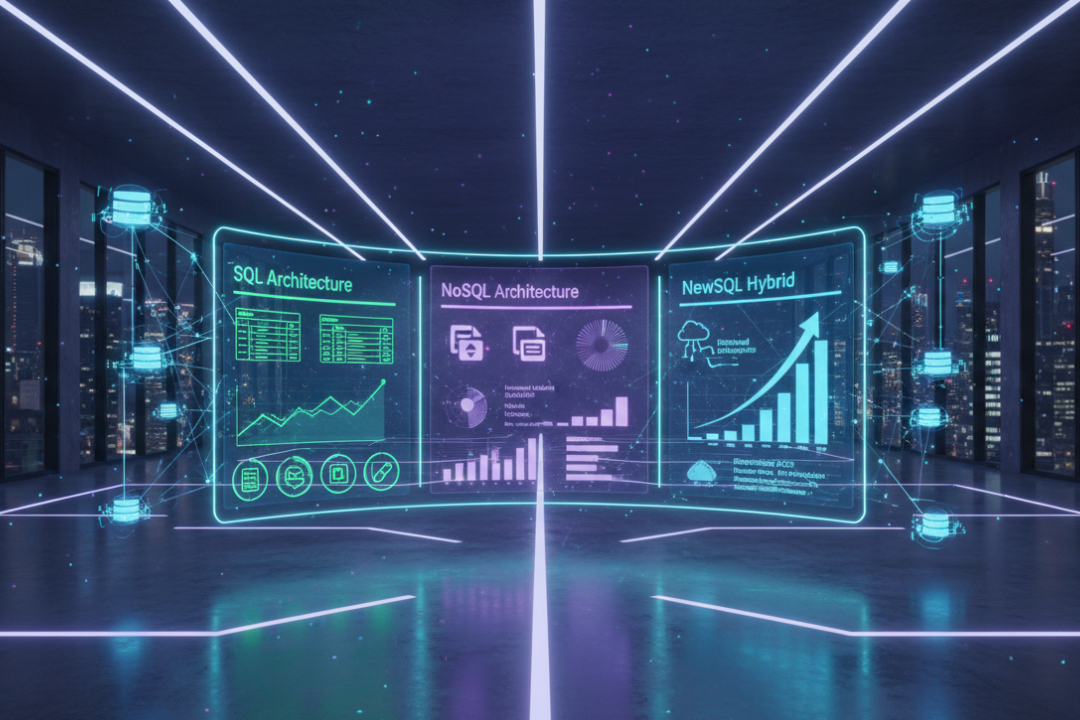
When to Use Which
Choosing the right database architecture depends on business objectives, workload characteristics, scalability requirements, and operational complexity.
SQL databases are ideal when applications require strong consistency, relational integrity, transactional reliability, and structured reporting.
Financial systems, ERP software, inventory management platforms, healthcare applications, and enterprise business solutions commonly rely on SQL databases.
NoSQL databases are best suited for highly scalable applications handling large volumes of unstructured, semi-structured, or rapidly evolving data.
Modern mobile applications, content platforms, AI-powered systems, ecommerce catalogs, social networks, and real-time analytics environments often benefit from NoSQL architectures.
Graph databases are especially effective for recommendation systems, fraud detection platforms, cybersecurity intelligence, social networking applications, and knowledge graph solutions.
NewSQL platforms are ideal for organizations that require both distributed scalability and strong transactional consistency.
Global SaaS products, fintech applications, ecommerce marketplaces, payment systems, and distributed enterprise platforms increasingly adopt NewSQL architectures to support cloud-native scalability without sacrificing reliability.
Modern database selection guide strategies frequently involve polyglot persistence, where multiple database technologies operate together within a unified architecture.
Developer Infotech helps businesses evaluate, select, and implement scalable database ecosystems aligned with performance objectives, operational efficiency, and long-term digital transformation goals.
Scaling Strategies
Modern applications require database architectures capable of handling increasing workloads, user growth, data expansion, and geographic distribution efficiently.
Vertical scaling increases server resources such as CPU, memory, and storage within a single machine.
While relatively simple to implement, vertical scaling eventually encounters hardware limitations and rising infrastructure costs.
Horizontal scaling distributes workloads across multiple servers, nodes, or regions.
This approach improves fault tolerance, availability, performance, and long-term scalability.
Sharding remains a widely used strategy for distributing datasets across multiple database instances.
By partitioning data intelligently, organizations can improve workload distribution and reduce performance bottlenecks.
Replication improves resilience and availability by maintaining synchronized copies of data across multiple servers and geographic locations.
Read replicas also help reduce query load and improve application responsiveness.
Caching platforms such as Redis continue to play a major role in modern scalability strategies by reducing database load and minimizing latency.
In 2026, database scalability increasingly relies on cloud-native infrastructure, Kubernetes orchestration, containerized deployments, serverless architectures, and automated resource management.
Developer Infotech builds scalable database infrastructures optimized for enterprise software, ecommerce systems, AI platforms, SaaS products, and distributed cloud environments.
Database Performance Optimization
Database optimization remains essential for maintaining application speed, responsiveness, and operational efficiency.
Indexing continues to be one of the most effective methods for improving query performance.
Well-designed indexes significantly reduce retrieval times and improve performance across large datasets.
Query optimization also plays a critical role.
Poorly designed queries can consume excessive resources, increase latency, and negatively impact user experience.
Modern database platforms increasingly utilize query analyzers, execution planners, and automated optimization tools to improve performance.
Caching layers reduce repeated database access for frequently requested information and help improve scalability.
Connection pooling, load balancing, replication strategies, and workload distribution further enhance operational efficiency.
Monitoring platforms provide valuable visibility into database performance, resource utilization, slow queries, infrastructure bottlenecks, and capacity planning requirements.
AI-assisted observability and automated performance tuning are becoming increasingly common in modern database management environments.
Developer Infotech helps organizations optimize database performance through scalable architecture design, cloud-native infrastructure strategies, advanced backend engineering, and proactive monitoring solutions.
Migration Considerations
Migrating between database systems requires careful planning, testing, and risk management.
Organizations moving from SQL to NoSQL, modernizing legacy systems, adopting NewSQL platforms, or transitioning to cloud-native databases must evaluate schema compatibility, application dependencies, performance requirements, and operational complexity.
Successful database migration strategies should include:
- Comprehensive data validation
- Backup and recovery planning
- Rollback procedures
- Performance benchmarking
- Security verification
- Application compatibility testing
- User acceptance testing
Minimizing downtime remains especially important for enterprise applications, ecommerce platforms, financial systems, and customer-facing services.
Modern migration tools, cloud-native replication services, automated synchronization platforms, and database modernization frameworks have significantly simplified migration workflows.
Organizations should also evaluate governance, compliance requirements, data residency considerations, and long-term operational costs before selecting a new database architecture.
Developer Infotech helps businesses modernize legacy database infrastructures through scalable migration strategies, cloud-native transformation initiatives, performance optimization, and enterprise-grade database engineering solutions.