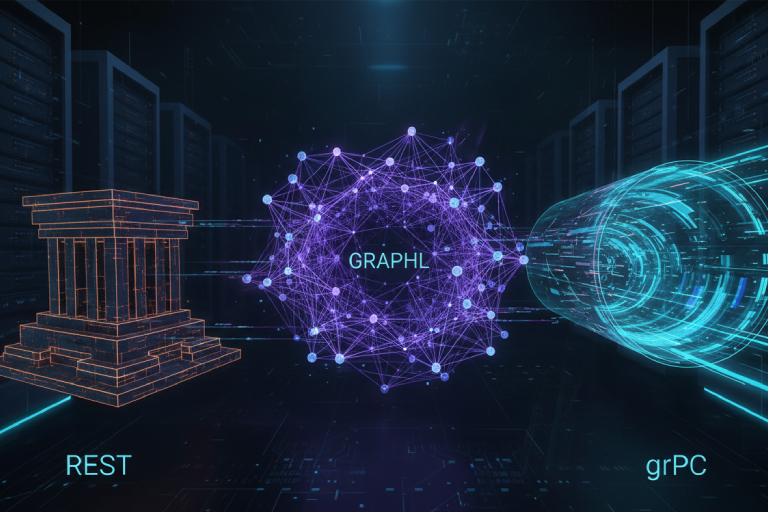
Introduction – API Architecture Evolution
Modern applications depend heavily on APIs to connect frontend systems, mobile applications, cloud services, AI platforms, IoT ecosystems, and enterprise software environments. As organizations continue adopting cloud-native architectures, microservices, edge computing, and real-time digital experiences, selecting the right API technology has become a critical architectural decision.
The discussion around rest vs graphql vs grpc 2026 reflects the growing need for scalable, high-performance, secure, and flexible communication systems. Each API architecture offers distinct advantages depending on project requirements, performance expectations, scalability goals, and operational complexity.
REST APIs continue to be the most widely adopted standard because of their simplicity, interoperability, and mature ecosystem support. GraphQL has gained significant popularity for frontend-driven applications that require flexible data retrieval, while gRPC has become a preferred solution for high-performance service-to-service communication and cloud-native infrastructures.
Modern businesses building ecommerce platforms, SaaS applications, AI-powered systems, enterprise dashboards, mobile applications, and distributed microservices environments must evaluate API architectures carefully to support long-term scalability, maintainability, and performance.
Developer Infotech helps businesses implement scalable API solutions through Web Development, Laravel Development, Mobile App Development, AI Solutions, and enterprise-grade Custom Software Development services optimized for modern digital ecosystems.
REST APIs
REST (Representational State Transfer) remains one of the most widely used API architectures in modern software development. REST APIs use standard HTTP methods such as GET, POST, PUT, PATCH, and DELETE to perform operations on resources.
One of REST’s biggest advantages is simplicity.
Developers can easily understand, build, test, and maintain RESTful APIs using familiar web technologies. This makes REST highly accessible for startups, enterprise applications, ecommerce platforms, content management systems, and mobile applications.
REST APIs are stateless, meaning every request contains all information required to process the operation. This characteristic simplifies scalability, load balancing, and distributed deployment strategies.
In modern api architecture comparison discussions, REST continues to dominate public-facing APIs because of broad industry support, extensive tooling, and compatibility across programming languages, frameworks, and cloud platforms.
REST APIs integrate seamlessly with frontend frameworks such as React, Vue, Angular, Svelte, and Next.js, while also supporting backend technologies like Laravel, Node.js, Django, Spring Boot, ASP.NET, and Go.
Another major advantage is native HTTP caching support.
Since REST leverages standard HTTP protocols, organizations can use browser caching, CDNs, reverse proxies, and edge caching technologies to improve performance and reduce infrastructure costs.
However, REST has some limitations.
One common challenge is over-fetching and under-fetching data. Clients may receive unnecessary information or require multiple requests to retrieve related resources across endpoints.
As applications become increasingly dynamic and frontend-driven, developers often require more flexible data querying capabilities than traditional REST structures provide.
Despite these limitations, REST remains highly effective for CRUD-based applications, third-party integrations, public APIs, enterprise systems, and business applications where simplicity, reliability, and interoperability are primary priorities.
Developer Infotech frequently implements REST APIs for ecommerce platforms, enterprise portals, WordPress integrations, SaaS systems, and custom web applications requiring scalable backend communication.
GraphQL
GraphQL is a query language and runtime designed to address many of the flexibility limitations associated with traditional REST APIs.
Unlike REST, which typically exposes multiple endpoints, GraphQL uses a single endpoint that allows clients to request exactly the data they need.
In the ongoing discussion around graphql vs rest api, GraphQL is often preferred for frontend-heavy applications requiring optimized data retrieval and highly dynamic user experiences.
One of GraphQL’s biggest advantages is eliminating over-fetching and under-fetching issues.
Rather than receiving predefined response structures, clients specify exactly which fields and relationships they require.
This significantly improves frontend efficiency, especially in mobile applications, SaaS dashboards, ecommerce platforms, and component-driven frontend architectures.
GraphQL also supports nested queries, allowing developers to retrieve related information within a single request.
This reduces network traffic, minimizes latency, and improves overall application responsiveness.
Modern ecommerce ecosystems, enterprise dashboards, social platforms, and customer portals frequently adopt GraphQL to manage complex data relationships efficiently.
Another major advantage is strong schema typing.
GraphQL APIs define structured schemas that improve documentation, validation, discoverability, and collaboration between frontend and backend teams.
Schema-first development approaches have become increasingly common in large-scale organizations because they improve consistency and reduce integration issues.
GraphQL also supports real-time functionality through subscriptions, enabling live updates for chat systems, collaboration platforms, analytics dashboards, notification systems, and monitoring applications.
However, GraphQL introduces additional complexity compared to REST.
Developers must carefully optimize resolvers, caching mechanisms, and database queries to avoid performance bottlenecks.
Caching can also be more challenging because GraphQL typically operates through a single endpoint rather than leveraging traditional HTTP caching patterns.
Security and authorization require careful planning as clients have greater flexibility when querying data structures.
Despite these considerations, GraphQL continues growing rapidly within modern frontend ecosystems, composable architectures, and enterprise applications requiring flexible data delivery.
Developer Infotech implements GraphQL APIs for enterprise software, ecommerce ecosystems, AI-powered dashboards, SaaS products, and modern digital platforms requiring efficient and flexible communication layers.
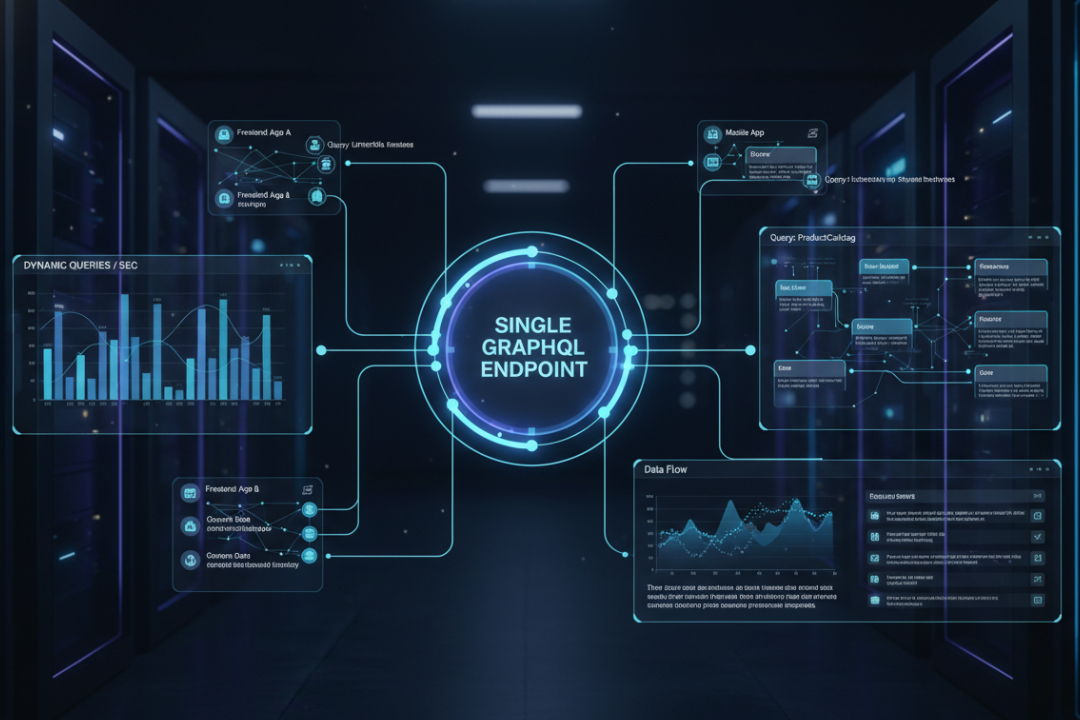
gRPC
gRPC is a high-performance Remote Procedure Call (RPC) framework designed for efficient communication between distributed systems, cloud-native applications, and microservices architectures.
Unlike REST and GraphQL, which primarily rely on JSON, gRPC uses Protocol Buffers (Protobuf) for data serialization.
This binary serialization format significantly reduces payload size while improving transmission speed and processing efficiency.
In modern rest vs graphql vs grpc 2026 discussions, gRPC is increasingly preferred for internal microservices communication, real-time processing systems, AI infrastructures, cloud-native platforms, and high-throughput backend architectures.
One of gRPC’s greatest strengths is performance.
Its support for HTTP/2 enables multiplexing, bidirectional streaming, header compression, and persistent connections, resulting in lower latency and faster communication.
This makes gRPC highly suitable for enterprise software, fintech systems, gaming infrastructures, machine learning platforms, streaming applications, and large-scale distributed systems.
gRPC also supports multiple communication patterns, including:
- Unary communication
- Server streaming
- Client streaming
- Bidirectional streaming
These capabilities provide exceptional flexibility for modern real-time applications.
Another major advantage is automatic code generation.
Developers can generate strongly typed client and server implementations across multiple programming languages directly from Protobuf definitions.
This improves consistency, reduces development effort, and minimizes integration errors across distributed environments.
gRPC also enforces strict service contracts and schema definitions, improving maintainability and reliability within large engineering teams.
However, gRPC is less browser-friendly than REST and GraphQL.
Because web browsers do not fully support native gRPC communication, organizations often require proxy layers such as gRPC-Web for frontend integration.
Debugging and testing can also be more challenging because binary payloads are not as human-readable as JSON responses.
Despite these limitations, gRPC continues becoming a foundational technology for modern platform engineering, distributed computing, AI infrastructure, and cloud-native application development.
Developer Infotech leverages gRPC for enterprise-grade systems, AI-powered platforms, cloud-native infrastructures, and high-performance backend architectures requiring efficient service-to-service communication.
Performance Comparison
Performance remains one of the most important considerations when evaluating rest vs graphql vs grpc 2026 architectures.
REST APIs are reliable, mature, and easy to implement, but they can become less efficient in complex applications that require multiple requests and larger payloads to retrieve related data.
GraphQL improves frontend efficiency by allowing clients to request only the data they need through a single endpoint.
This reduces unnecessary data transfer, minimizes network overhead, and improves performance for mobile applications, SaaS dashboards, and highly interactive user interfaces.
However, GraphQL query execution can become resource-intensive if schemas, resolvers, and backend data sources are not optimized correctly.
In large-scale systems, poorly designed GraphQL implementations may create performance bottlenecks despite reducing network requests.
gRPC continues to offer the highest raw performance among the three technologies.
Its binary Protocol Buffers serialization, HTTP/2 transport, multiplexing capabilities, and support for streaming make it exceptionally efficient for distributed systems and service-to-service communication.
For internal microservices communication, AI workloads, real-time processing systems, and cloud-native infrastructures, gRPC frequently outperforms both REST and GraphQL.
From a developer experience perspective, REST remains the easiest architecture to build, test, and troubleshoot, while GraphQL and gRPC require more advanced architectural planning and operational expertise.
Businesses evaluating api development best practices should balance performance requirements with maintainability, scalability, security, and long-term operational complexity.
Use Case Scenarios
Different API architectures serve different business goals, technical requirements, and scalability needs.
REST APIs remain ideal for standard CRUD applications, public APIs, CMS platforms, WordPress integrations, third-party services, and traditional web applications where simplicity and compatibility are key priorities.
REST also works exceptionally well for ecommerce systems, business portals, enterprise dashboards, and integration-focused applications requiring predictable communication patterns.
GraphQL is highly effective for frontend-driven applications requiring flexible and efficient data retrieval.
Modern SaaS dashboards, ecommerce experiences, mobile applications, social platforms, and personalized user interfaces benefit significantly from GraphQL’s ability to reduce over-fetching and optimize data delivery.
Applications requiring real-time collaboration, live updates, and personalized experiences also benefit from GraphQL subscriptions and modern event-driven architectures.
gRPC excels in high-performance backend systems and distributed environments.
Microservices ecosystems, AI platforms, machine learning pipelines, fintech applications, IoT infrastructures, cloud-native services, and streaming platforms frequently rely on gRPC for efficient service communication.
In 2026, many enterprises adopt hybrid API ecosystems rather than relying on a single architecture.
For example:
- REST for public-facing APIs
- GraphQL for frontend applications
- gRPC for internal microservices communication
- Event-driven APIs for asynchronous workflows
This multi-layered approach allows organizations to optimize performance, developer productivity, scalability, and user experience simultaneously.
Developer Infotech helps businesses design scalable API ecosystems through Laravel Development, Custom Software Development, AI Solutions, Mobile App Development, and enterprise backend architecture planning.
When to Use What
Choosing between REST, GraphQL, and gRPC depends on application requirements, user experience goals, scalability expectations, and infrastructure architecture.
REST remains the preferred choice when simplicity, interoperability, broad adoption, and ease of maintenance are primary objectives.
Organizations developing standard web applications, public APIs, enterprise portals, and traditional software systems continue to benefit from REST’s mature ecosystem and proven reliability.
GraphQL is ideal when frontend flexibility and optimized data delivery are critical.
Applications with highly interactive interfaces, mobile-first experiences, multi-device ecosystems, and complex relational data structures often achieve better performance and efficiency using GraphQL.
gRPC is the preferred solution for high-performance backend communication and cloud-native distributed architectures.
Organizations operating large-scale microservices environments, AI systems, fintech platforms, IoT infrastructures, and real-time processing systems benefit greatly from gRPC’s speed, efficiency, and scalability.
In modern microservices api design, organizations increasingly combine REST, GraphQL, gRPC, and event-driven communication models based on workload requirements and business objectives.
Regardless of architecture choice, organizations should continue following strong api development best practices, including:
- API versioning
- Authentication and authorization
- Rate limiting
- Encryption
- Monitoring and observability
- Caching strategies
- Automated testing
- Scalability planning
Developer Infotech helps organizations evaluate and implement API architectures aligned with long-term growth, performance goals, and digital transformation initiatives.
Code Examples
REST APIs typically expose resource-based endpoints using standard HTTP methods.
A REST request might retrieve user information from an endpoint such as:
/api/users/1
GraphQL APIs generally expose a single endpoint where clients define exactly which fields they need through structured queries.
A GraphQL query can retrieve user information, associated orders, preferences, and related records within a single request.
gRPC communication relies on Protocol Buffer definitions stored in .proto files.
Developers define services, methods, and message structures that generate strongly typed client and server implementations across multiple programming languages.
Each approach offers distinct development workflows, operational considerations, and architectural advantages depending on business requirements and scalability objectives.
Developer Infotech helps organizations implement scalable API architectures using Laravel, Node.js, React, cloud-native systems, AI-powered platforms, and enterprise backend engineering strategies.
Future of API Development
The future of API development in 2026 continues moving toward highly scalable, intelligent, event-driven, and distributed architectures.
As AI-powered applications, cloud-native platforms, edge computing, and real-time digital experiences expand, API ecosystems are becoming increasingly performance-focused, secure, and automated.
GraphQL adoption continues growing within frontend-centric ecosystems where personalized user experiences and optimized data delivery are critical.
gRPC is strengthening its position within backend infrastructures, platform engineering initiatives, AI workloads, and microservices communication.
REST APIs remain highly relevant because of their simplicity, interoperability, reliability, and widespread industry adoption.
At the same time, organizations are increasingly adopting API gateways, service meshes, event-driven architectures, and AI-assisted API management platforms to improve scalability and governance.
Future API platforms will integrate:
- AI-powered optimization
- Advanced observability
- Automated documentation
- Enhanced security controls
- Real-time analytics
- Intelligent traffic management
- Zero-trust API security frameworks
Businesses that invest in scalable, secure, and adaptable API architectures today will be better positioned to support future innovation, digital transformation, and evolving customer expectations.
Developer Infotech helps organizations build future-ready API ecosystems through modern backend engineering, cloud-native architecture planning, AI integration, and enterprise-grade software development expertise.