REST vs GraphQL vs gRPC: Choosing the Right API Architecture in 2025
Introduction – API Architecture Evolution
Modern applications depend heavily on APIs to connect frontend systems, mobile applications, cloud services, and enterprise platforms. As businesses continue adopting distributed architectures and real-time digital experiences, selecting the right API technology has become a critical technical decision.
The debate around rest vs graphql vs grpc 2025 reflects the growing need for scalable, high-performance, and flexible communication systems. Each architecture offers distinct advantages depending on project complexity, performance requirements, and scalability goals.
REST APIs have remained the industry standard for years due to simplicity and broad compatibility. GraphQL introduced a more flexible query-based approach for frontend-heavy applications, while gRPC emerged as a high-performance protocol optimized for microservices and internal system communication.
Modern businesses developing ecommerce platforms, SaaS products, enterprise dashboards, AI systems, and mobile applications must evaluate API architecture carefully to ensure long-term scalability and maintainability.
Developer Infotech helps businesses implement scalable API solutions through Web Development, Laravel Development, Mobile App Development, AI Solutions, and enterprise-grade custom software systems optimized for modern digital ecosystems.
REST APIs
REST (Representational State Transfer) remains one of the most widely used API architectures in modern software development. REST APIs use standard HTTP methods such as GET, POST, PUT, and DELETE to perform operations on resources.
One of the biggest strengths of REST is simplicity. Developers can easily understand and implement RESTful APIs using standard web technologies. This makes REST highly accessible for startups, enterprise systems, ecommerce platforms, and mobile applications.
REST APIs are stateless, meaning every request contains all required information. This simplifies scalability and improves reliability in distributed systems.
In modern api architecture comparison discussions, REST continues to dominate public APIs due to broad ecosystem support and compatibility across programming languages and frameworks.
REST APIs also integrate seamlessly with frontend frameworks like React, Vue, and Angular, as well as backend technologies such as Laravel, Node.js, Django, and Spring Boot.
Another major advantage is caching support. Since REST leverages HTTP standards, caching mechanisms can significantly improve performance and reduce server load.
However, REST also has limitations. One common challenge is over-fetching and under-fetching data. Clients may receive unnecessary data or require multiple requests to retrieve related resources.
As applications become more dynamic and frontend-driven, developers often require more flexible query capabilities than REST traditionally provides.
Despite these limitations, REST remains highly effective for CRUD-based systems, public APIs, and standard business applications where simplicity and interoperability are priorities.
Developer Infotech frequently implements REST APIs for ecommerce platforms, WordPress integrations, enterprise portals, and custom web applications requiring scalable backend communication.
GraphQL
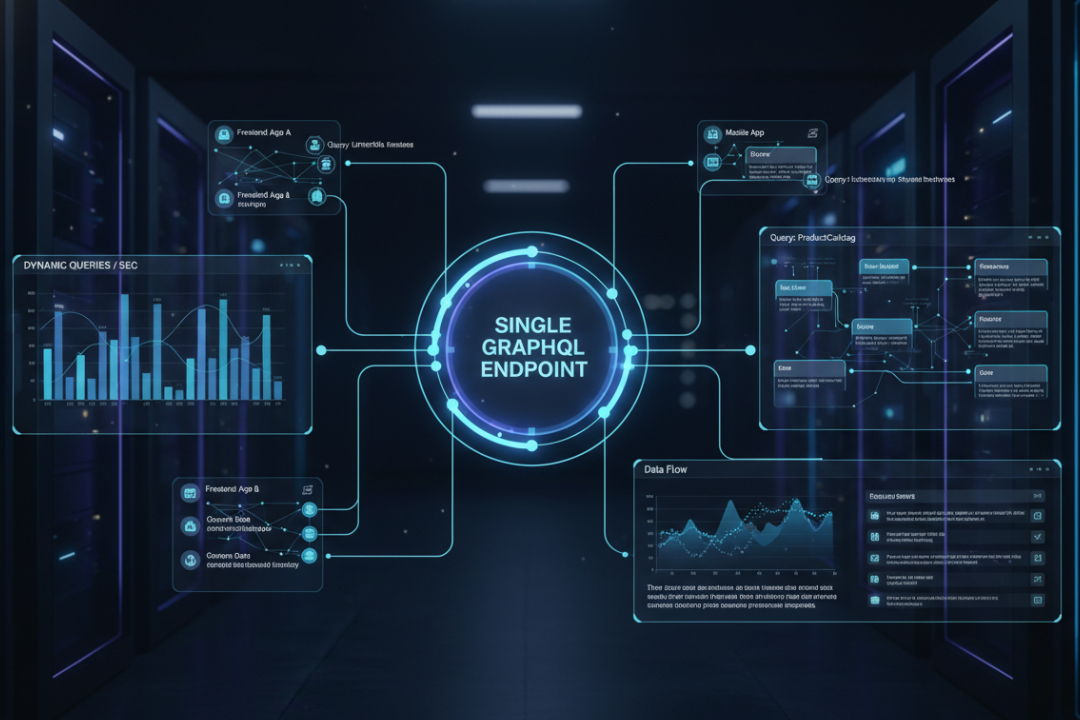
GraphQL is a query language and runtime developed to solve many of the flexibility limitations associated with REST APIs. It enables clients to request exactly the data they need through a single endpoint.
In the ongoing discussion around graphql vs rest api, GraphQL is often preferred for frontend-heavy applications requiring efficient data fetching and dynamic user experiences.
One of GraphQL’s biggest advantages is eliminating over-fetching and under-fetching problems. Instead of receiving predefined response structures, clients specify precisely which fields are required.
This significantly improves frontend efficiency, especially in mobile applications and component-driven frontend architectures.
GraphQL also supports nested queries, allowing developers to retrieve related data in a single request. This reduces network overhead and improves performance in complex applications.
Modern ecommerce platforms, SaaS dashboards, and social applications frequently adopt GraphQL to manage highly interactive interfaces and dynamic data relationships.
Another major advantage is strong schema typing. GraphQL APIs define structured schemas that improve documentation, validation, and developer collaboration.
This makes frontend and backend development more predictable and scalable in large teams.
GraphQL also supports real-time updates through subscriptions, enabling live data synchronization for chat applications, analytics dashboards, and collaborative systems.
However, GraphQL introduces additional complexity compared to REST.
Developers must carefully optimize queries to prevent excessive server load and inefficient database operations. Poorly structured queries can impact scalability significantly.
Caching is another challenge. Since GraphQL typically uses a single endpoint, traditional HTTP caching becomes less straightforward compared to REST APIs.
Security and authorization also require careful planning because clients have greater flexibility in querying data.
Despite these considerations, GraphQL continues to grow rapidly in modern microservices api design strategies and frontend-driven ecosystems.
Large-scale digital platforms increasingly rely on GraphQL for personalized user experiences, mobile responsiveness, and scalable frontend architectures.
Developer Infotech implements GraphQL APIs for enterprise applications, ecommerce ecosystems, AI dashboards, and modern web platforms requiring flexible and optimized data communication.
gRPC
gRPC is a high-performance RPC (Remote Procedure Call) framework developed for efficient communication between distributed systems and microservices.
Unlike REST and GraphQL, gRPC uses Protocol Buffers (Protobuf) instead of JSON for data serialization. This significantly improves speed and reduces payload size.
In modern rest vs graphql vs grpc 2025 discussions, gRPC is increasingly preferred for internal microservices communication, real-time systems, and high-throughput backend infrastructures.
One of the biggest strengths of gRPC is performance. Binary serialization and HTTP/2 support enable extremely fast communication with low latency.
This makes gRPC highly suitable for enterprise platforms, financial systems, streaming applications, gaming infrastructures, and AI processing systems.
gRPC also supports bidirectional streaming, enabling real-time communication between services and clients.
Another advantage is automatic code generation. Developers can generate client and server code in multiple programming languages directly from Protobuf definitions.
This improves consistency and accelerates development workflows in large distributed systems.
gRPC also provides strong typing and strict contract enforcement, reducing communication inconsistencies between services.
However, gRPC is less browser-friendly compared to REST and GraphQL. Since browsers do not fully support native gRPC directly, additional proxy layers are often required for frontend communication.
Debugging and testing can also be more complex because binary payloads are less human-readable than JSON responses.
Despite these challenges, gRPC is becoming a foundational technology for scalable backend infrastructures and modern cloud-native architectures.
Developer Infotech leverages gRPC in enterprise-grade systems, AI-powered platforms, and high-performance backend architectures requiring efficient service-to-service communication.
Performance Comparison
Performance plays a major role when evaluating rest vs graphql vs grpc 2025 architectures.
REST APIs are simple and highly reliable, but they can become inefficient in complex frontend applications due to multiple requests and larger payloads.
GraphQL improves frontend efficiency by reducing unnecessary data transfer and consolidating requests into a single endpoint.
This makes GraphQL highly effective for mobile applications and dynamic frontend systems requiring flexible data structures.
However, GraphQL query execution can become resource-intensive if schemas and resolvers are not optimized properly.
gRPC delivers the highest raw performance among the three technologies.
Its binary serialization and HTTP/2 support enable lower latency, faster communication, and improved scalability in distributed systems.
For internal microservices communication, gRPC often outperforms both REST and GraphQL significantly.
From a developer experience perspective, REST remains the easiest to implement and debug, while GraphQL and gRPC require more advanced architectural planning.
Businesses evaluating api development best practices should balance performance needs with maintainability, scalability, and ecosystem compatibility.
Use Case Scenarios
Different API architectures serve different business and technical requirements.
REST APIs are ideal for standard CRUD applications, public APIs, WordPress integrations, and traditional web platforms where simplicity and compatibility are priorities.
REST also works well for ecommerce systems, CMS platforms, and third-party integrations requiring stable and predictable communication patterns.
GraphQL is highly suitable for frontend-driven applications with dynamic user interfaces.
Mobile applications, SaaS dashboards, social platforms, and ecommerce experiences benefit significantly from GraphQL’s flexible querying capabilities.
Applications requiring real-time updates and personalized content delivery also gain advantages from GraphQL subscriptions and efficient data fetching.
gRPC excels in high-performance internal systems and distributed architectures.
Microservices ecosystems, AI processing pipelines, fintech platforms, IoT systems, and streaming infrastructures frequently rely on gRPC for efficient communication.
Modern enterprises often combine multiple API architectures within the same ecosystem.
For example, businesses may use REST for public APIs, GraphQL for frontend communication, and gRPC for internal microservices interactions.
This hybrid strategy allows organizations to optimize performance, scalability, and developer productivity across different system layers.
Developer Infotech helps businesses design scalable API ecosystems through Laravel Development, Custom Software Development, AI Solutions, and enterprise backend architecture planning.
When to Use What
Choosing between REST, GraphQL, and gRPC depends on project requirements, frontend complexity, scalability goals, and infrastructure architecture.
REST is the best choice when simplicity, compatibility, and broad adoption are priorities.
Businesses developing standard web applications, public APIs, and traditional enterprise systems often benefit from REST’s reliability and mature ecosystem.
GraphQL is ideal when frontend flexibility and optimized data fetching are critical.
Applications with highly interactive interfaces, mobile-first experiences, and complex relational data structures often achieve better efficiency with GraphQL.
gRPC is the preferred solution for high-performance backend communication and microservices ecosystems.
Organizations handling large-scale distributed systems, real-time processing, and AI workloads benefit significantly from gRPC’s speed and efficiency.
In modern microservices api design, many enterprises combine all three architectures strategically depending on operational requirements.
Following strong api development best practices such as versioning, security, caching, monitoring, and scalability planning remains essential regardless of architecture choice.
Code Examples
REST APIs typically expose resource-based endpoints using standard HTTP methods.
A REST request might retrieve user information from an endpoint such as /api/users/1.
GraphQL APIs expose a single endpoint where clients define required fields within structured queries.
A GraphQL query can request user data, orders, and related information within a single request.
gRPC communication relies on Protobuf definitions that generate strongly typed client-server contracts.
Developers define services and message structures inside .proto files, enabling efficient service communication across distributed systems.
Each approach offers different development workflows and architectural advantages depending on business requirements and scalability goals.
Developer Infotech helps organizations implement scalable API architectures using Laravel, Node.js, React, cloud-native systems, and enterprise backend engineering strategies.
Future of API Development
The future of APIs is moving toward highly scalable, intelligent, and distributed architectures.
As cloud-native systems, AI-driven applications, and real-time digital experiences continue growing, API ecosystems will become increasingly performance-focused and modular.
GraphQL adoption will continue expanding in frontend-heavy ecosystems, while gRPC will strengthen its role in backend infrastructure and microservices communication.
REST APIs will remain highly relevant due to their simplicity, reliability, and widespread industry adoption.
Future API platforms will increasingly integrate automation, observability, AI-powered optimization, and advanced security frameworks to support next-generation digital ecosystems.