
Introduction – Digital India Initiative
India’s digital economy continues to expand rapidly in 2026 as businesses across industries adopt cloud technologies, artificial intelligence, automation, digital commerce, and data-driven operations. Government-led initiatives supporting digital infrastructure, digital payments, startup innovation, and technology adoption continue to accelerate business modernization across the country.
For small and medium enterprises, implementing a strong digital transformation strategy sme india 2026 is no longer a competitive advantage—it has become a business necessity. Organizations that fail to modernize risk losing operational efficiency, customer engagement, market relevance, and growth opportunities in increasingly digital-first markets.
Modern consumers expect seamless online experiences, mobile accessibility, personalized interactions, fast response times, self-service options, and consistent engagement across multiple channels. SMEs must therefore invest in scalable digital infrastructure, business automation, cloud ecosystems, cybersecurity, and data-driven decision-making.
The continued growth of ecommerce, SaaS platforms, generative AI, intelligent automation, and mobile-first customer journeys has fundamentally reshaped how Indian businesses operate, compete, and scale.
Developer Infotech supports SMEs through Web Development, Shopify Development, Laravel Development, AI Solutions, Mobile App Development, UI/UX Design, and Custom Software Development services that help businesses modernize operations and achieve sustainable growth.
What is Digital Transformation?
Digital transformation refers to the integration of digital technologies into business operations, customer experiences, workflows, decision-making processes, and organizational culture.
It is not simply about implementing new software tools. It involves reimagining how businesses operate, serve customers, manage information, automate workflows, and create value through technology.
A successful digital transformation roadmap focuses on improving efficiency, reducing manual processes, enhancing visibility, strengthening security, and delivering superior customer experiences.
Modern SMEs increasingly adopt cloud computing, CRM platforms, ERP systems, automation tools, AI-powered analytics, business intelligence platforms, customer service solutions, and mobile applications to modernize operations.
Digital transformation also enables businesses to become more agile, resilient, and adaptable in rapidly changing market conditions.
For example, organizations can automate invoicing, inventory tracking, customer support, lead nurturing, marketing campaigns, internal approvals, and reporting processes.
This reduces operational bottlenecks, minimizes errors, and significantly improves productivity.
Customer expectations remain a major driver of digital transformation.
Today’s customers expect frictionless digital interactions, personalized recommendations, real-time communication, mobile accessibility, and consistent experiences across channels.
Businesses that fail to deliver digital convenience often struggle to retain customers and remain competitive.
Data has also become one of the most valuable business assets.
Digital transformation enables organizations to collect, analyze, and leverage business data for strategic decision-making, performance optimization, customer engagement, forecasting, and growth planning.
Cloud technologies continue to play a central role in modern transformation strategies because they provide scalable infrastructure, operational flexibility, and lower upfront investment requirements.
This makes digital modernization increasingly accessible for growing businesses.
The evolution of sme digitization india continues helping organizations across retail, healthcare, education, manufacturing, logistics, professional services, and ecommerce sectors become more efficient and competitive.
Developer Infotech helps SMEs implement scalable digital solutions aligned with operational goals, customer engagement strategies, and long-term business growth.
Why SMEs Must Transform Now
Indian SMEs operate in highly competitive markets where customer expectations, operational demands, and technology standards continue evolving rapidly.
Businesses that rely heavily on manual processes and traditional systems often face inefficiencies, limited scalability, higher operational costs, slower decision-making, and reduced competitiveness.
Digital transformation enables SMEs to improve productivity, automate repetitive workflows, strengthen customer relationships, and increase operational agility.
The continued growth of ecommerce, digital payments, cloud infrastructure, AI-powered business tools, and automation platforms has fundamentally changed how customers interact with businesses.
Consumers increasingly prefer businesses that provide digital accessibility, personalized experiences, self-service capabilities, mobile-friendly platforms, and rapid customer support.
Organizations adopting modern technologies also gain stronger operational visibility through analytics dashboards, AI-powered insights, and real-time reporting systems.
This enables business leaders to make faster and more informed decisions.
Automation reduces dependence on manual workflows while improving accuracy and efficiency.
For example, automated inventory management systems, CRM platforms, intelligent customer support tools, and cloud-based accounting software significantly improve operational performance.
The widespread adoption of hybrid and remote work models has further accelerated cloud adoption among SMEs.
Cloud-based ecosystems enable secure collaboration, remote accessibility, and operational continuity regardless of location.
Cybersecurity has become another major driver of transformation.
Legacy systems often lack adequate protection against modern cyber threats, ransomware attacks, phishing campaigns, and data breaches.
Modern cloud-based infrastructures provide enhanced security, monitoring, backup systems, and compliance capabilities.
Organizations implementing strong business automation strategies are also improving customer retention, reducing operational costs, and increasing scalability.
Digital transformation is now directly connected to long-term business growth, profitability, resilience, and sustainability.
Developer Infotech helps SMEs modernize operations through scalable digital platforms, automation systems, cloud infrastructure, AI integration, and enterprise technology solutions designed for future growth.
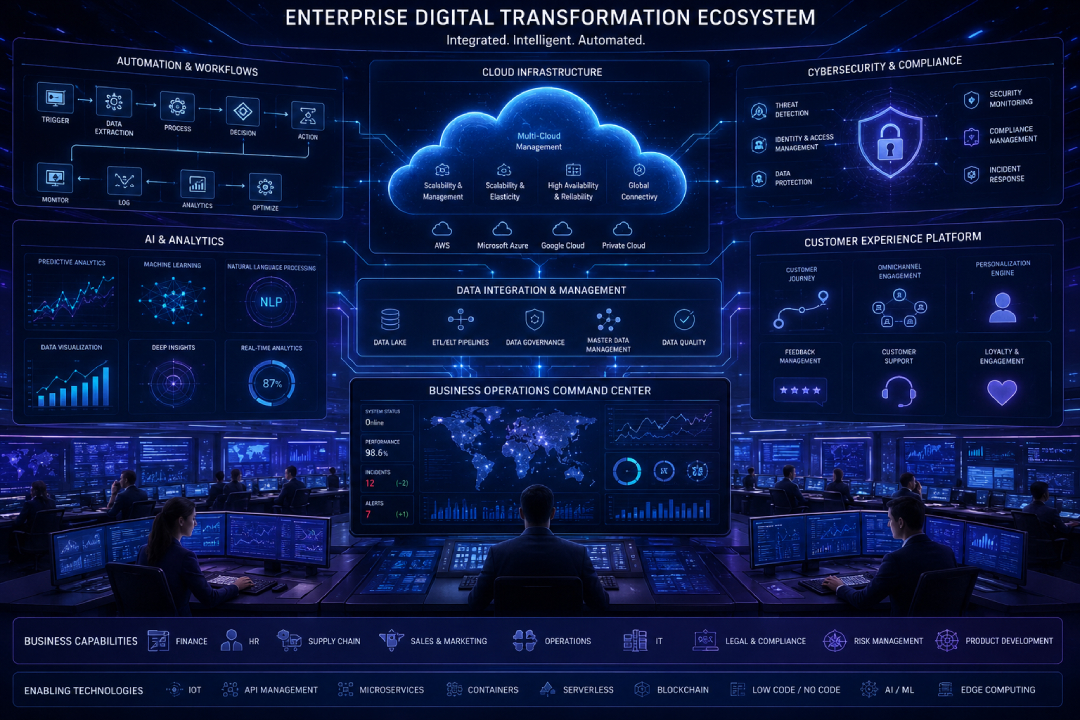
Digital Transformation Pillars
― Process Automation
Process automation remains one of the most important pillars of digital transformation in 2026.
Modern businesses leverage automation platforms to streamline repetitive activities such as invoicing, inventory management, customer communication, lead nurturing, payroll administration, workflow approvals, and reporting.
Automation improves efficiency, reduces manual errors, increases consistency, and allows employees to focus on strategic initiatives.
AI-powered automation and intelligent workflow systems are becoming increasingly common among SMEs seeking operational scalability.
Businesses implementing business automation strategies often achieve significant productivity gains and long-term cost savings.
― Customer Experience
Customer experience continues to serve as a major competitive differentiator.
Businesses must deliver seamless interactions across websites, mobile applications, ecommerce platforms, social channels, customer portals, and support systems.
Modern UX strategies emphasize personalization, accessibility, mobile optimization, intuitive navigation, and fast performance.
Digital transformation enables organizations to provide consistent and engaging experiences across multiple customer touchpoints.
Companies investing in UI/UX Design, customer journey optimization, and modern frontend technologies often improve satisfaction, loyalty, and conversion rates significantly.
― Data Analytics
Data analytics enables organizations to make informed decisions based on operational performance, customer behavior, and market trends.
Modern analytics platforms provide real-time insights into sales, marketing performance, customer engagement, operational efficiency, and business growth opportunities.
AI-powered analytics tools increasingly help businesses identify patterns, predict outcomes, forecast demand, and optimize workflows.
SMEs that adopt data-driven decision-making gain stronger visibility into business performance and competitive opportunities.
― Cloud Adoption
Cloud computing remains the foundation of modern digital transformation initiatives.
Cloud platforms provide scalable infrastructure, remote accessibility, secure storage, operational flexibility, and business continuity capabilities.
Organizations can deploy websites, mobile apps, CRM systems, ERP platforms, AI tools, and analytics solutions without significant infrastructure investments.
Cloud adoption also supports hybrid work environments, collaboration, disaster recovery planning, and long-term scalability.
Modern cloud ecosystems enable SMEs to scale efficiently while reducing operational complexity and infrastructure management burdens.
― Cybersecurity
Cybersecurity has become a core component of every digital transformation roadmap.
As organizations digitize operations, they become increasingly exposed to cyber threats, ransomware attacks, phishing attempts, data breaches, and supply-chain vulnerabilities.
Modern cybersecurity strategies include multi-factor authentication, endpoint protection, cloud security controls, encryption, backup systems, zero-trust security models, and continuous monitoring.
Organizations implementing strong security frameworks strengthen customer trust, reduce risk exposure, and improve business resilience.
Developer Infotech helps SMEs implement secure digital infrastructures optimized for scalability, automation, cybersecurity, and long-term business growth.
Step-by-Step Roadmap
A successful digital transformation roadmap requires structured planning, business alignment, technology readiness, and scalable implementation strategies.
The first step is evaluating existing business processes and identifying operational inefficiencies.
Organizations should analyze workflows, customer journeys, data management systems, communication channels, reporting processes, and technology limitations.
This assessment helps businesses identify areas where modernization can deliver the highest impact.
The second step involves defining clear business objectives and measurable transformation goals.
Organizations should establish outcomes such as improved efficiency, reduced operational costs, enhanced customer experiences, stronger cybersecurity, increased automation, or greater scalability.
The next phase focuses on selecting the right technology ecosystem.
Businesses should choose solutions that align with operational requirements, budget constraints, integration needs, and long-term growth strategies.
Cloud infrastructure, CRM platforms, ecommerce systems, automation tools, analytics platforms, AI solutions, and mobile applications should work seamlessly together within the overall technology stack.
Implementation should follow a phased approach rather than attempting complete transformation all at once.
Incremental deployment minimizes operational disruption, reduces risks, and allows teams to adapt gradually to new technologies and workflows.
Employee enablement remains another essential component of successful transformation.
Organizations should invest in training programs, digital adoption strategies, and change management initiatives to maximize the value of technology investments.
Cybersecurity planning should also be integrated throughout implementation to protect business operations, customer information, and digital assets.
Performance monitoring plays a crucial role in measuring transformation success.
Businesses should continuously track operational efficiency, automation rates, customer engagement, employee productivity, revenue growth, and technology adoption metrics.
Digital transformation is not a one-time initiative.
Successful organizations continuously optimize processes, adopt emerging technologies, and refine customer experiences to remain competitive in evolving markets.
Developer Infotech provides end-to-end digital transformation consulting services that help SMEs plan, implement, and optimize scalable digital ecosystems.
Budget Planning for SMEs
Budget planning remains one of the most important aspects of digital transformation for small and medium enterprises.
Many SMEs still assume that modernization requires significant upfront investments, but cloud-based technologies, SaaS platforms, subscription models, and AI-powered tools have made digital adoption more affordable and accessible.
Businesses should prioritize investments that deliver immediate operational value and long-term scalability.
Examples include CRM systems, ecommerce platforms, automation software, cloud hosting, cybersecurity solutions, analytics tools, and mobile applications.
Cloud computing helps reduce infrastructure expenses by eliminating the need for large investments in physical hardware and maintenance.
Subscription-based software models further enable businesses to scale technology investments according to operational requirements.
A successful digital transformation strategy sme india 2026 should include both short-term implementation budgets and long-term growth planning.
Organizations should account for software licensing, implementation costs, employee training, cybersecurity investments, cloud infrastructure, maintenance services, and future scalability requirements.
Automation technologies frequently generate strong long-term ROI by reducing manual workloads, improving productivity, and lowering operational costs.
Businesses should also allocate dedicated budgets for cybersecurity, compliance readiness, data protection, and business continuity planning.
Strategic technology investments help SMEs improve operational efficiency, customer retention, revenue growth, and long-term competitiveness.
Developer Infotech helps businesses build cost-effective digital ecosystems optimized for operational efficiency, scalability, and sustainable growth.
Technology Stack Recommendations
Choosing the right technology stack is essential for successful digital transformation.
Modern SMEs require secure, scalable, AI-ready, and flexible technology ecosystems capable of supporting long-term business growth.
Cloud infrastructure platforms such as AWS, Azure, and Google Cloud continue to provide scalable hosting, automation capabilities, security controls, and operational flexibility.
Frontend technologies such as React, Next.js, Vue.js, and modern JavaScript frameworks help deliver fast, responsive, and user-friendly digital experiences.
Laravel continues to be a popular framework for custom business applications, enterprise platforms, and scalable web solutions, while Node.js remains widely used for real-time and API-driven applications.
Businesses building ecommerce platforms often choose Shopify, WooCommerce, Magento, or custom ecommerce architectures depending on their operational requirements and growth objectives.
CRM systems, ERP platforms, AI-powered analytics tools, customer support solutions, marketing automation platforms, and workflow automation software further improve business visibility and operational efficiency.
Generative AI tools and intelligent automation platforms are also becoming increasingly important for SMEs seeking productivity gains and competitive advantages.
Mobile-first development remains a critical priority because mobile devices continue to dominate customer engagement and digital interactions.
Developer Infotech helps SMEs select and implement modern technology stacks optimized for performance, security, scalability, AI readiness, and customer experience.
Common Challenges & Solutions
Many SMEs encounter challenges during digital transformation due to budget limitations, technical skill gaps, organizational resistance, integration complexity, and cybersecurity concerns.
Legacy systems often create operational bottlenecks and compatibility issues when integrating with modern technologies.
Organizations can address these challenges through phased implementation strategies, cloud adoption, and careful modernization planning.
Employee resistance is another common obstacle.
Successful transformation initiatives require leadership support, employee engagement, training programs, and clear communication regarding business benefits.
Technical complexity can also slow transformation efforts.
Working with experienced technology partners helps businesses reduce implementation risks and improve project outcomes.
Cybersecurity concerns remain a significant challenge as businesses become increasingly dependent on digital systems.
Organizations should implement secure infrastructure, identity management controls, endpoint protection, backup systems, and continuous monitoring practices.
Integration challenges can arise when multiple platforms need to exchange information and operate seamlessly.
Businesses should prioritize solutions that support APIs, automation workflows, and scalable architectures.
Developer Infotech helps organizations overcome transformation challenges through customized implementation strategies, scalable development practices, cybersecurity expertise, and long-term technology consulting.
Success Metrics
Measuring transformation success requires organizations to track operational, financial, customer-focused, and technology-related performance indicators.
Key metrics often include process automation rates, productivity improvements, operational cost reductions, revenue growth, customer retention, employee adoption rates, and customer satisfaction scores.
Analytics dashboards and AI-powered reporting platforms provide real-time visibility into business performance and transformation outcomes.
Organizations implementing effective business automation strategies frequently achieve measurable improvements in efficiency, accuracy, scalability, and profitability.
Customer engagement metrics such as website performance, mobile usage, conversion rates, average response times, and retention rates also help evaluate transformation effectiveness.
Technology-focused KPIs such as system uptime, cloud utilization, cybersecurity incident reduction, and workflow efficiency provide additional visibility into operational improvements.
Continuous measurement enables businesses to identify optimization opportunities and maximize the value of digital investments.
Developer Infotech helps businesses implement data-driven transformation strategies supported by analytics, automation systems, AI-powered insights, and scalable digital infrastructure.
Developer Infotech Digital Consulting
Developer Infotech provides end-to-end digital transformation consulting services for SMEs seeking to modernize operations and compete effectively in increasingly digital markets.
The company helps organizations implement scalable cloud infrastructure, automation systems, ecommerce platforms, AI-powered solutions, mobile applications, business intelligence platforms, and enterprise software ecosystems.
Developer Infotech combines technical expertise with business-focused strategies to create digital solutions aligned with operational objectives, customer expectations, and long-term scalability requirements.
Services include Web Development, Shopify Development, Laravel Development, Mobile App Development, UI/UX Design, AI Solutions, and Custom Software Development.
By focusing on performance, security, scalability, automation, and customer experience, Developer Infotech helps Indian SMEs accelerate digital transformation and build future-ready business ecosystems.